Bay Area Real Estate - February 2026 Market Report

Bay Area Real Estate - February 2026 Market Report

Select a Market Report to Read:

North Bay
East Bay
Silicon Valley
San Francisco


Welcome to the latest San Francisco Real Estate Market Report from Kinoko Real Estate! As your trusted local Real Estate experts in San Francisco, we're committed to providing you with the most accurate and insightful data to guide your home-buying or selling journey in this dynamic city.

The Local Lowdown

Quick Take:

  • Single-family home prices are surging in San Francisco and parts of the North Bay, with year-over-year gains exceeding 16% and 19% in San Francisco and Marin County, respectively, while other pockets of the region are seeing modest declines.
  • Inventory levels have collapsed across the Bay Area, with single-family home inventory down by double digits in every submarket on a year-over-year basis.
  • Condos continue to struggle with pricing and longer days on market, while single-family homes are flying off the shelves in many areas.
  • Nearly every single-family home market in the Bay Area is firmly in seller's market territory, with several counties sitting at or below one month of supply.

Note: You can find the charts/graphs for the Local Lowdown at the end of this section.

*National Association of REALTORS® data is released two months behind, so we estimate the most recent month's data when possible and appropriate.

San Francisco and Marin County are leading an incredible surge in home prices

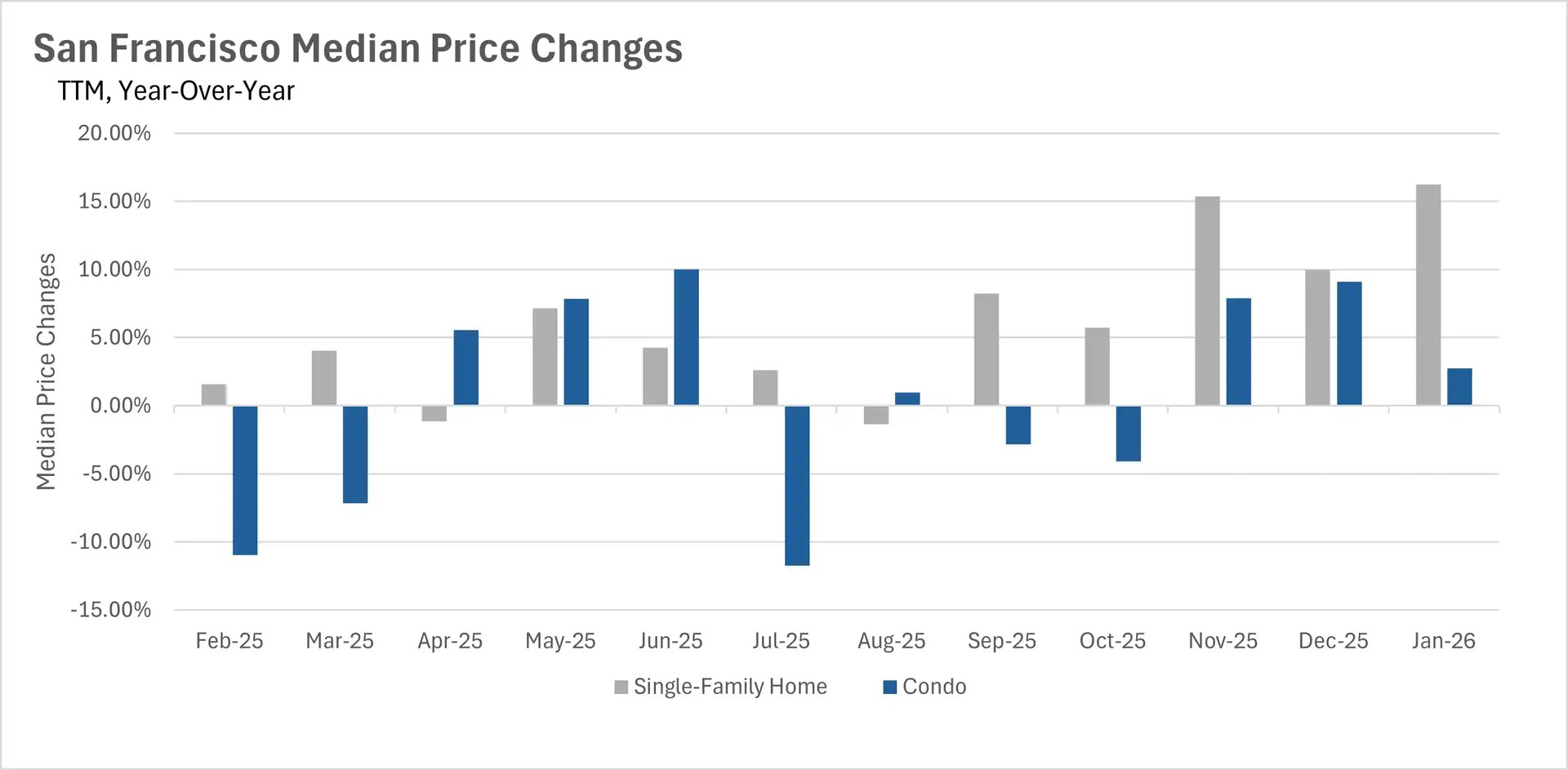
The Bay Area kicked off 2026 with some truly remarkable price appreciation in several key markets. San Francisco's single-family home market posted a stunning 16.23% year-over-year increase in median sale price, with the median home selling for $1,653,325. Not to be outdone, Marin County saw its median single-family home sell for $1,750,000, a 19.86% year-over-year jump. Napa County also posted impressive gains, with single-family homes up 18.75% to a median of $1,045,000. However, not every market is experiencing this level of growth. Santa Clara County saw its median single-family home price decline by 3.89%, while Sonoma and Solano Counties also posted slight year-over-year declines. The condo market continues to tell a very different story, with declines across Silicon Valley and significant weakness in Contra Costa County, where the median condo sold for 14.39% less than it did last January. San Francisco condos were a bright spot, posting a modest 2.77% year-over-year gain.

Inventory has reached critically low levels throughout the Bay Area

One of the biggest stories heading into 2026 is the dramatic decline in inventory across the Bay Area. After inventories built up throughout the spring and summer of 2025, the correction has been swift and severe. The North Bay saw the most dramatic contraction, with single-family home inventory plummeting 45.19% on a year-over-year basis and condo inventory dropping 36.60%. San Francisco isn't far behind, with single-family inventory down 37.82% and condo inventory down 36.94%, leaving fewer than 500 homes available for sale in the entire city. The East Bay saw declines of 18.58% for single-family homes and 20.03% for condos, while Silicon Valley's single-family inventory is down 12% year-over-year. New listings are beginning to pick up after the holiday slowdown, but they remain well below last year's levels in most markets. Until sellers begin entering the market in greater numbers, buyers will continue to face extremely limited options.

Condos are sitting on the market for dramatically longer, while single-family homes move quickly

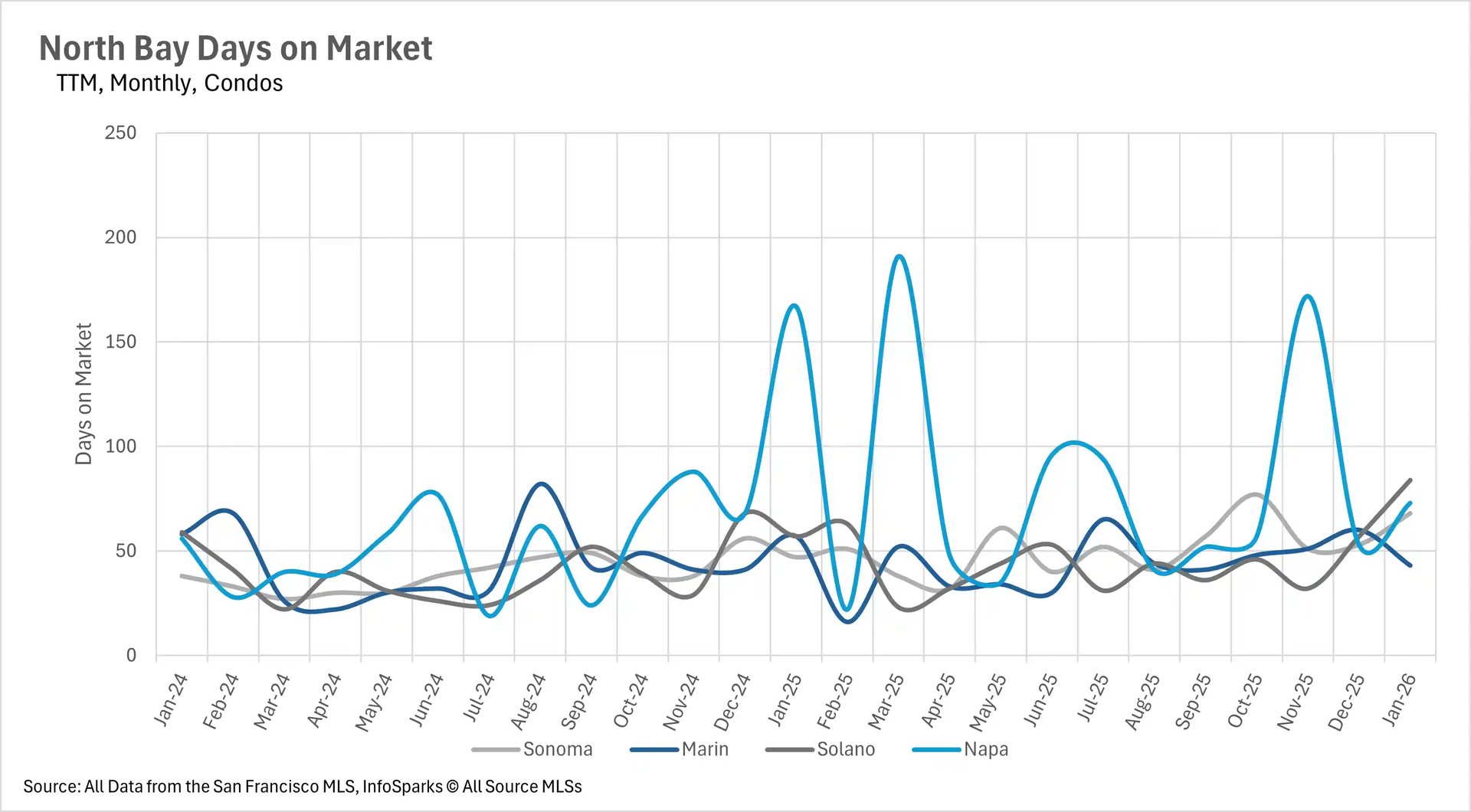
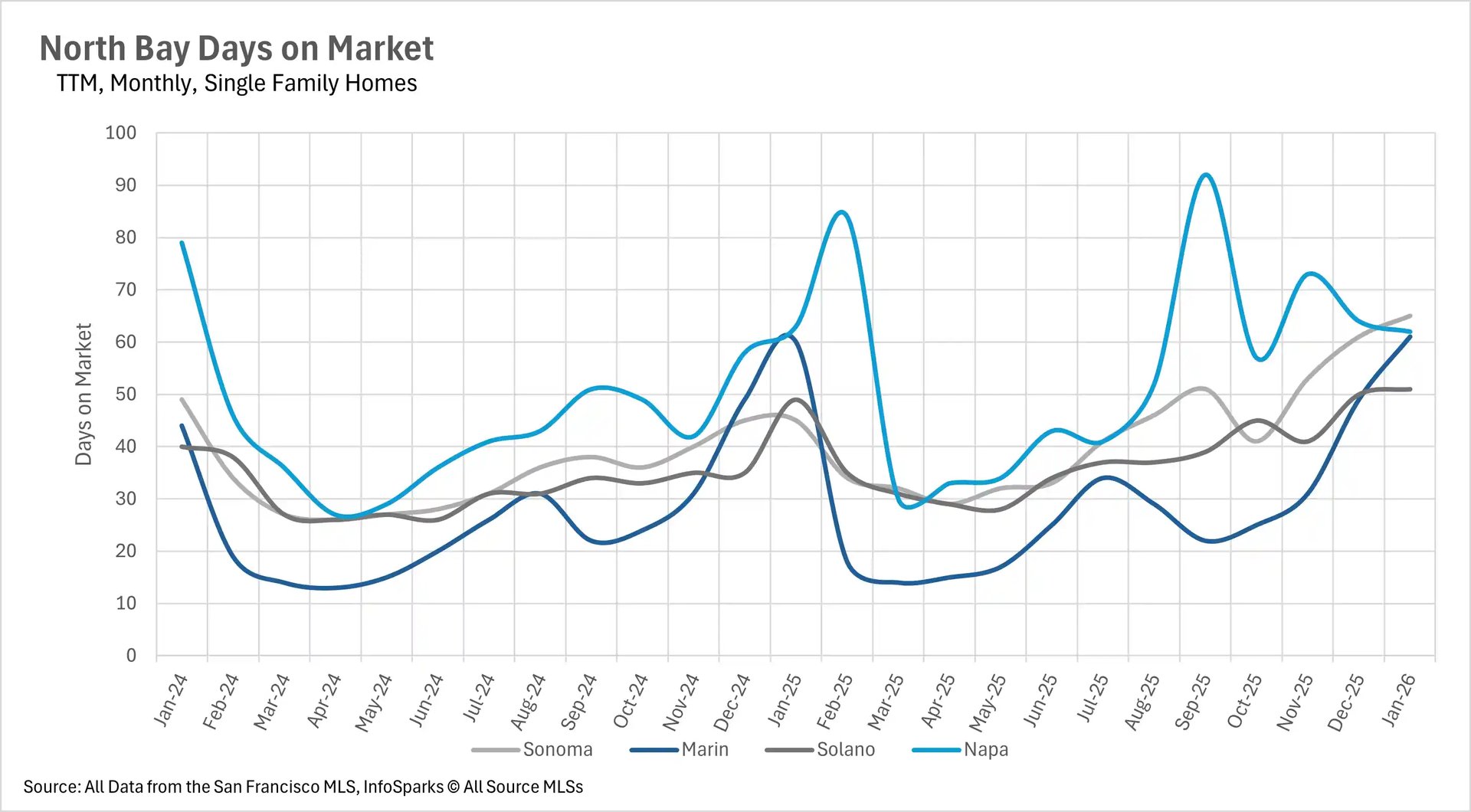
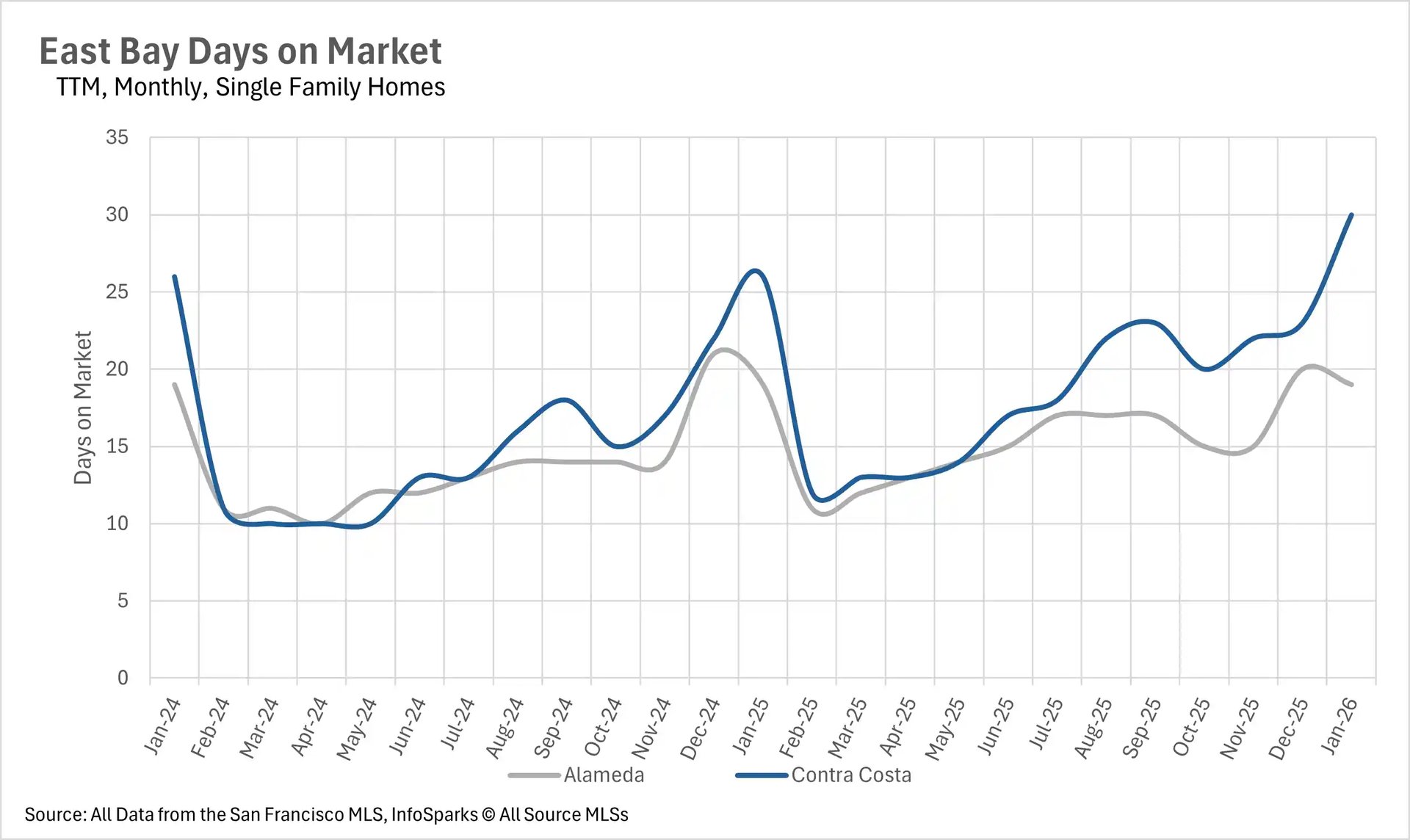
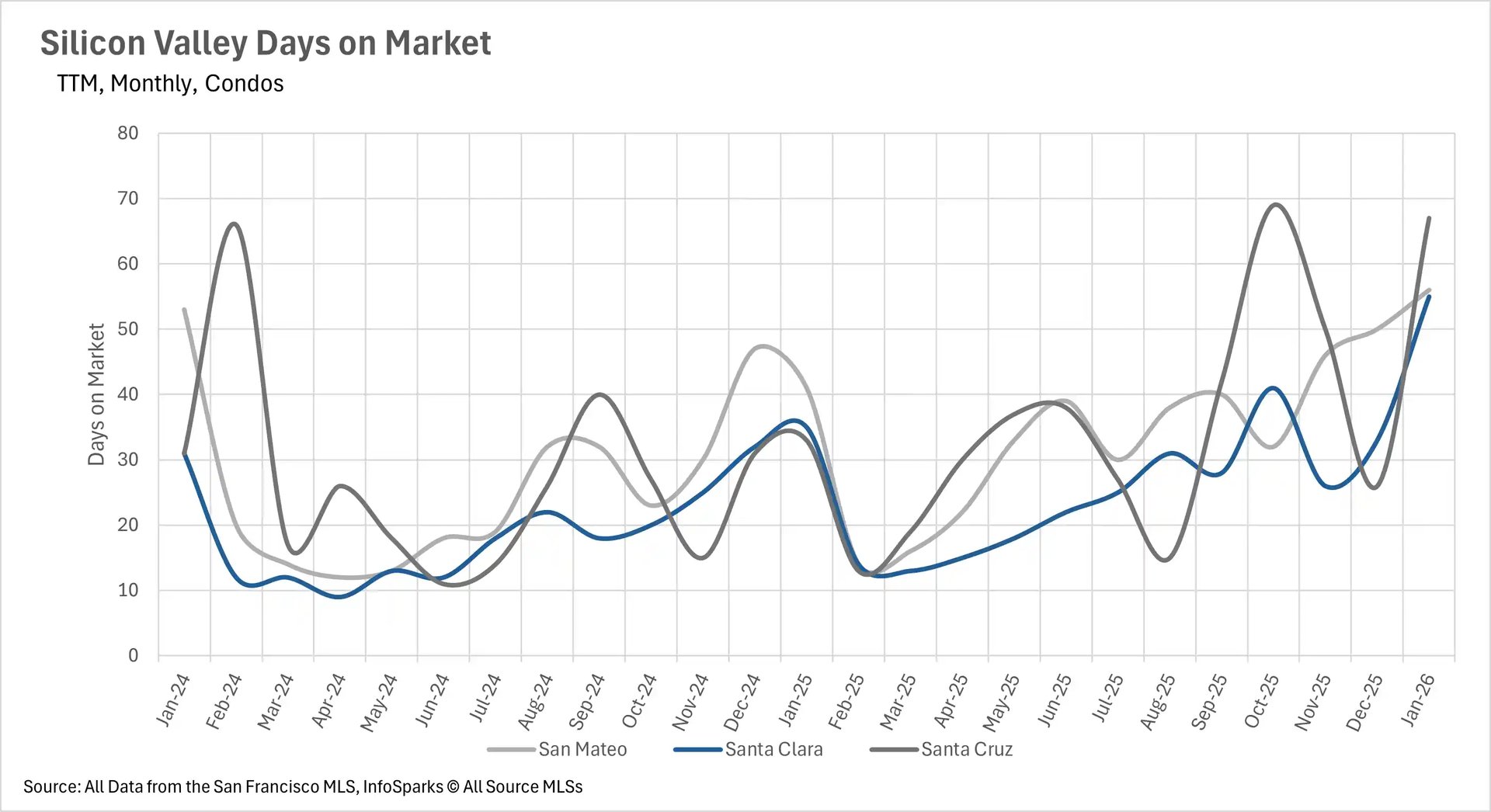
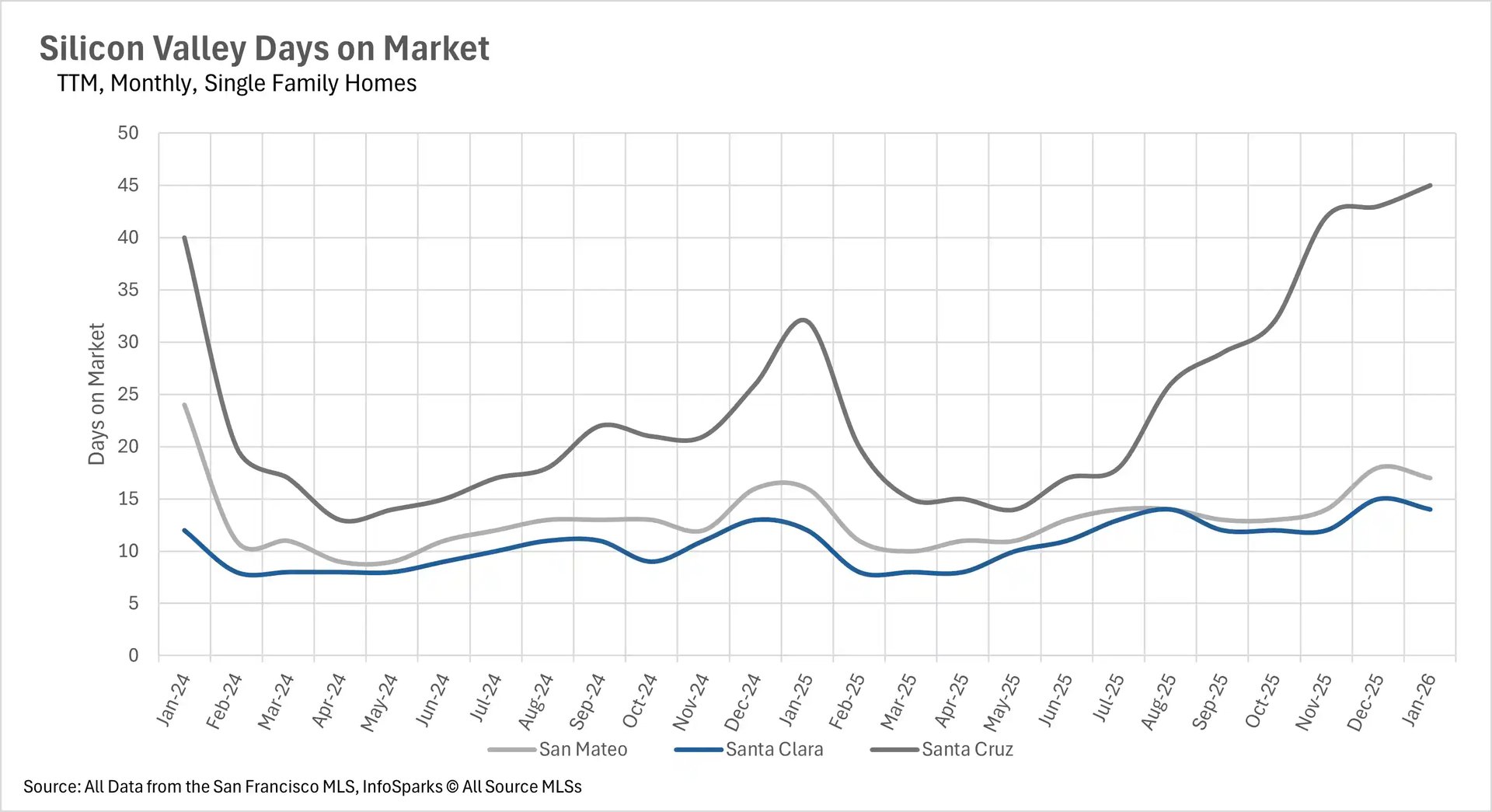
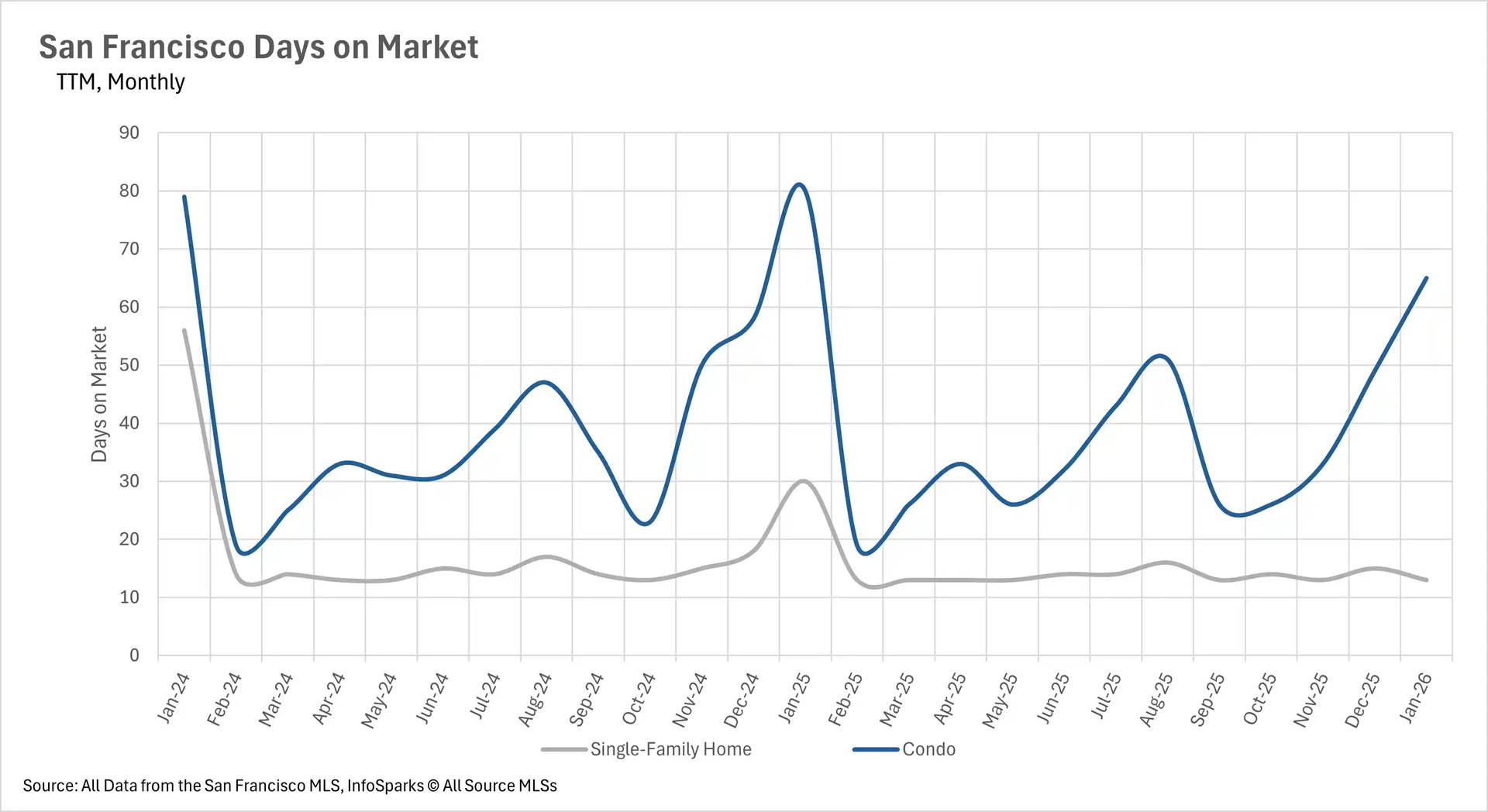
The gap between the single-family home market and the condo market continues to widen when it comes to how long listings are spending on the market. In San Francisco, the average single-family home is selling in just 13 days, a 56.67% decrease compared to last January. Alameda County single-family homes are also moving at a brisk pace, selling in just 19 days on average. However, the condo market is a completely different animal. Santa Clara County condos are spending an average of 55 days on the market, a 57.14% year-over-year increase, while Santa Cruz County condos are sitting for 67 days, more than double what we saw in January 2025. In the North Bay, Sonoma County single-family homes are spending 44.44% more time on the market despite plummeting inventory levels, suggesting that even in a tight market, buyers are being cautious and deliberate with their offers.

The Bay Area is overwhelmingly a seller's market heading into the spring

When determining whether a market is a buyers' market or a sellers' market, we look to the Months of Supply Inventory (MSI) metric. The state of California has historically averaged around three months of MSI, so any area with at or around three months of MSI is considered a balanced market. Any market that has lower than three months of MSI is considered a seller's market, whereas markets with more than three months of MSI are considered a buyers' market.

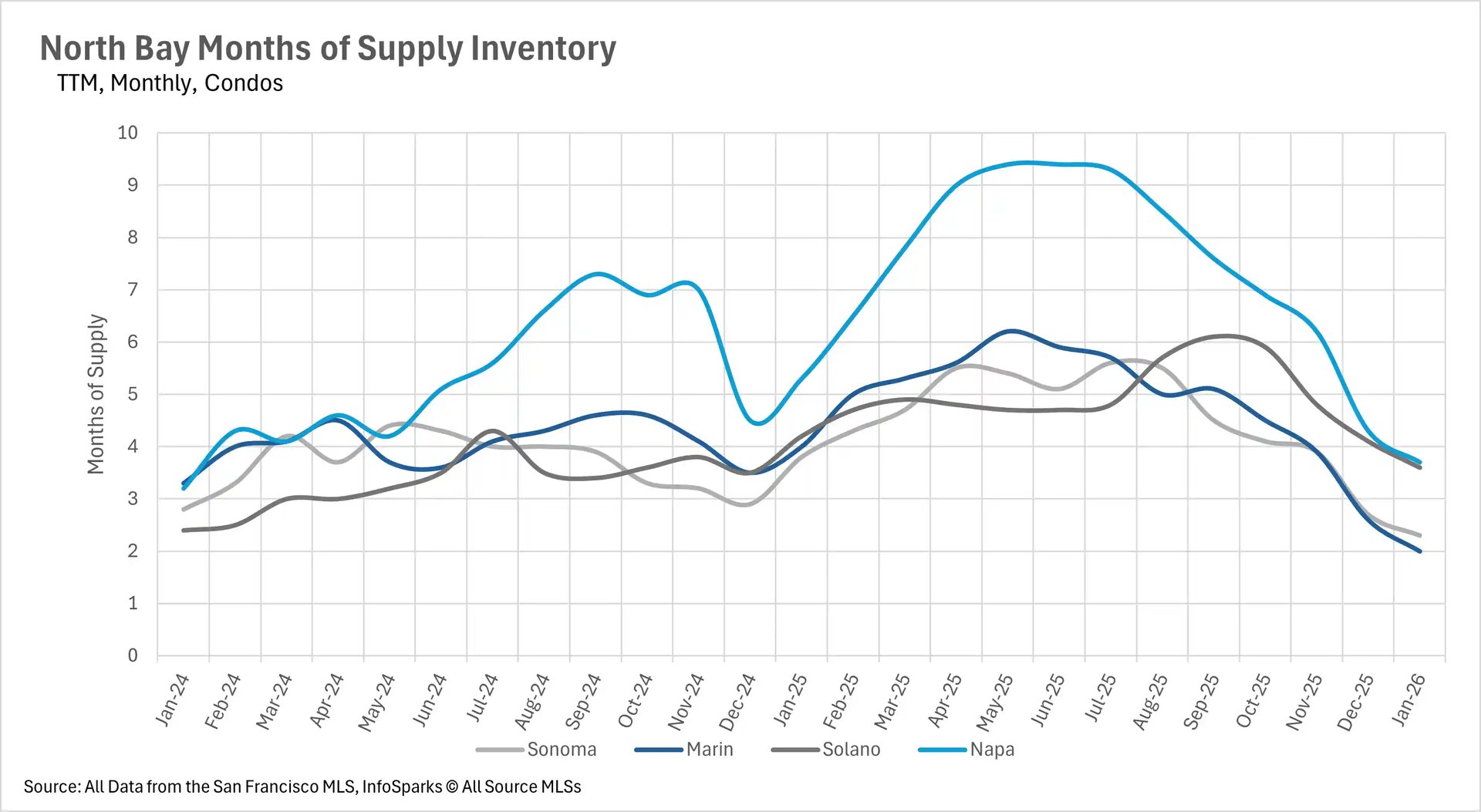
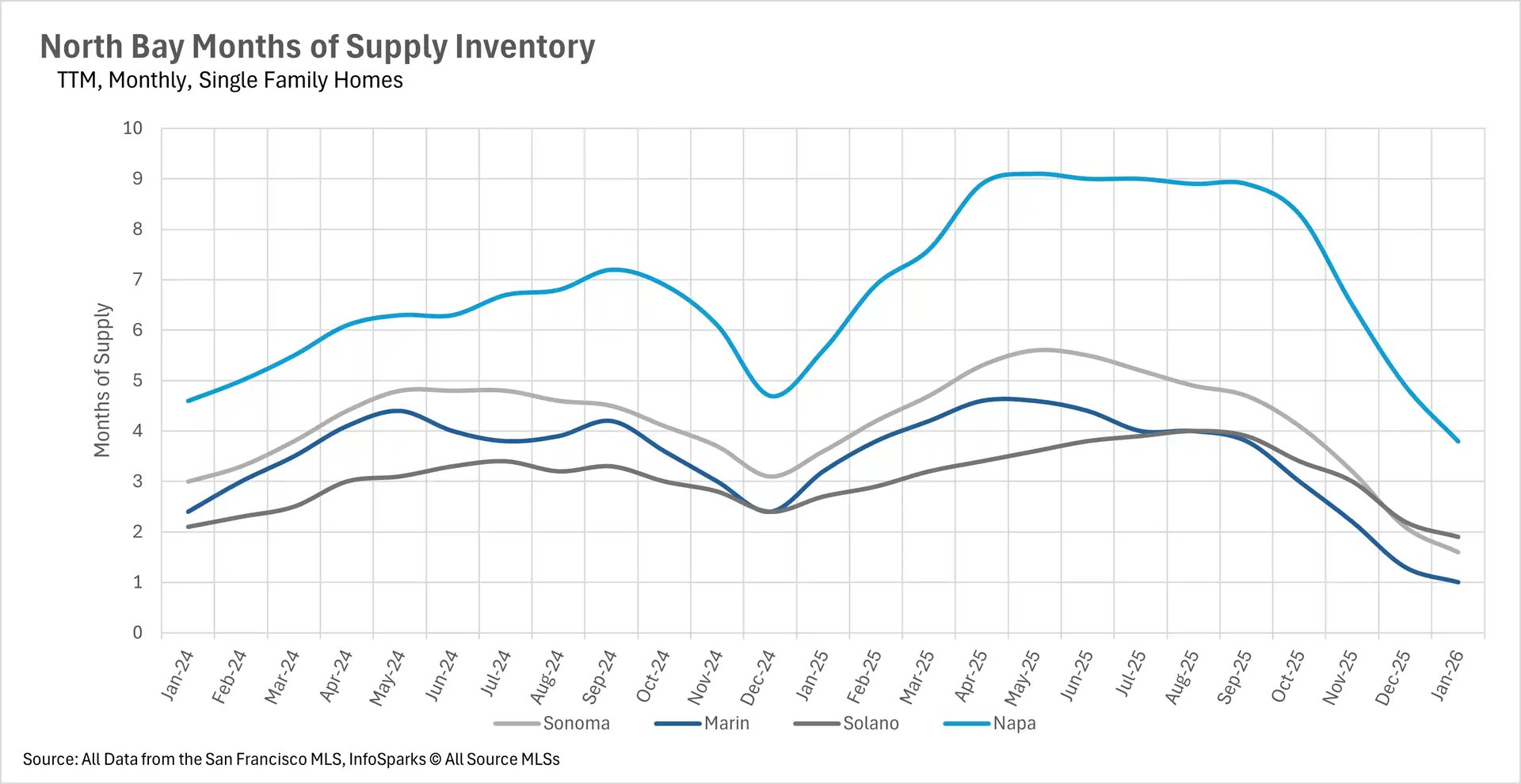
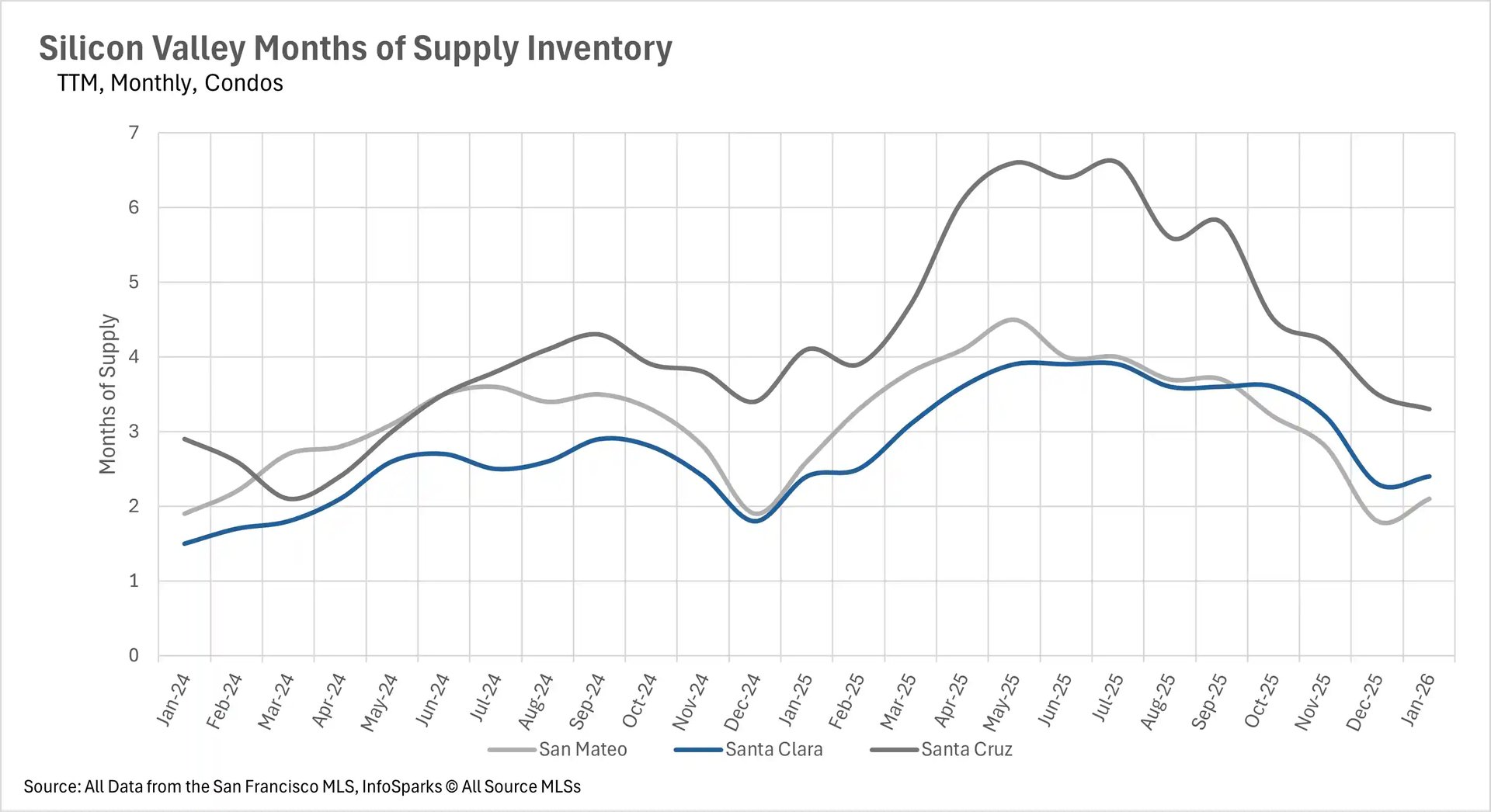
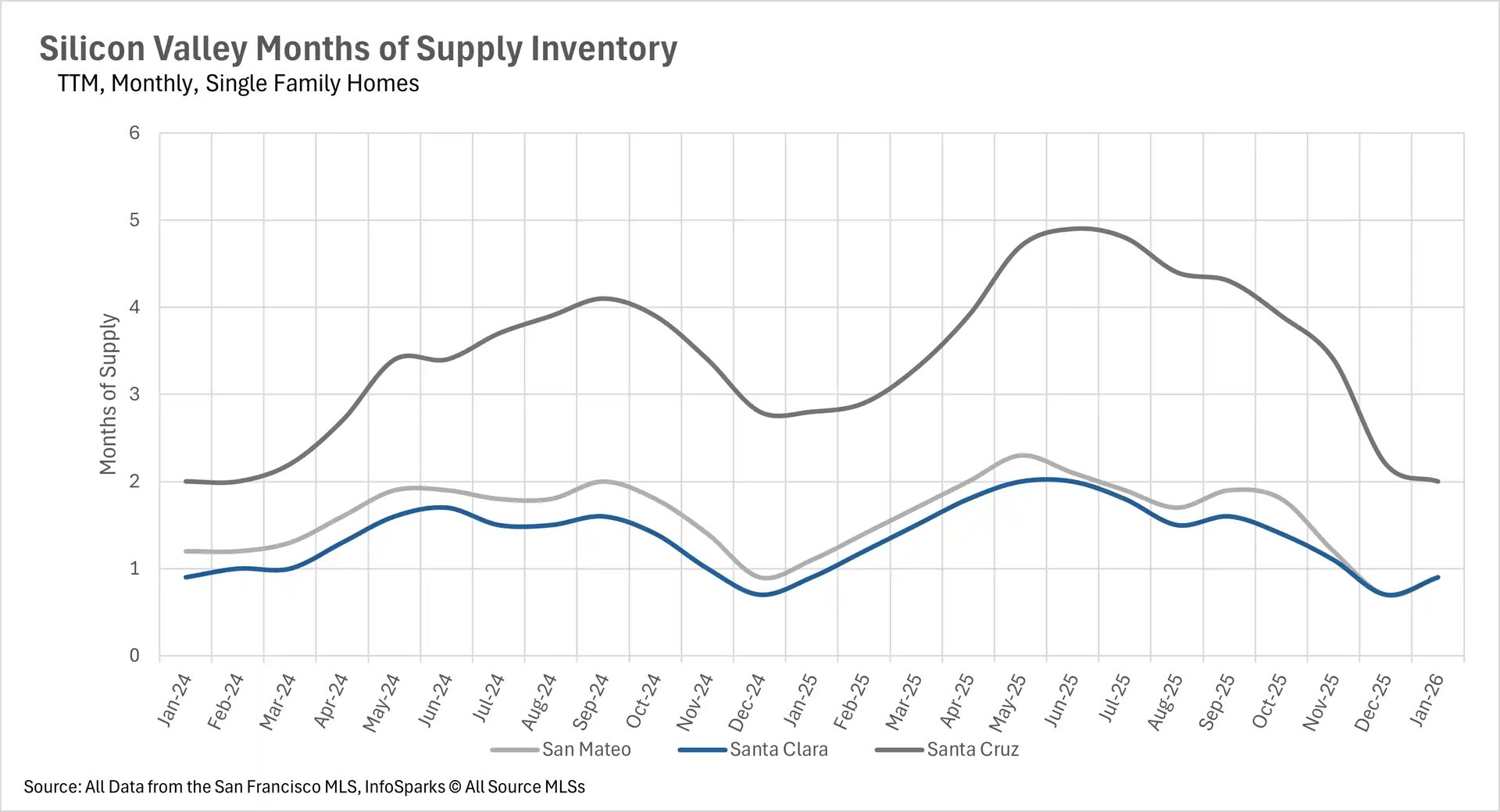
January brought seller's market conditions to nearly every corner of the Bay Area's single-family home market. San Francisco and Santa Clara County are sitting at just 0.8 and 0.9 months of supply, respectively, while Marin County has just 1 month of supply, down an incredible 68.75% year-over-year. Alameda County has 1.1 months, Contra Costa County has 1.5 months, and Sonoma County has 1.6 months. Even Napa County, which was a strong buyer's market throughout much of 2025, has dropped to 3.8 months. The condo market has also tightened considerably, though a few pockets remain in buyer's market territory, including Santa Cruz County at 3.3 months, Solano County at 3.6 months, and Napa County at 3.7 months. With inventory at historically low levels and the busy spring selling season right around the corner, sellers are in an excellent position heading into the next few months.
A wide-angle landscape photograph of a large, single-story house with green roofing, a white garage door, and beige stucco walls, situated on a sprawling green lawn. Palm trees and tropical plants surround the property, with lush, green mountains visible in the background under a partly cloudy blue sky.

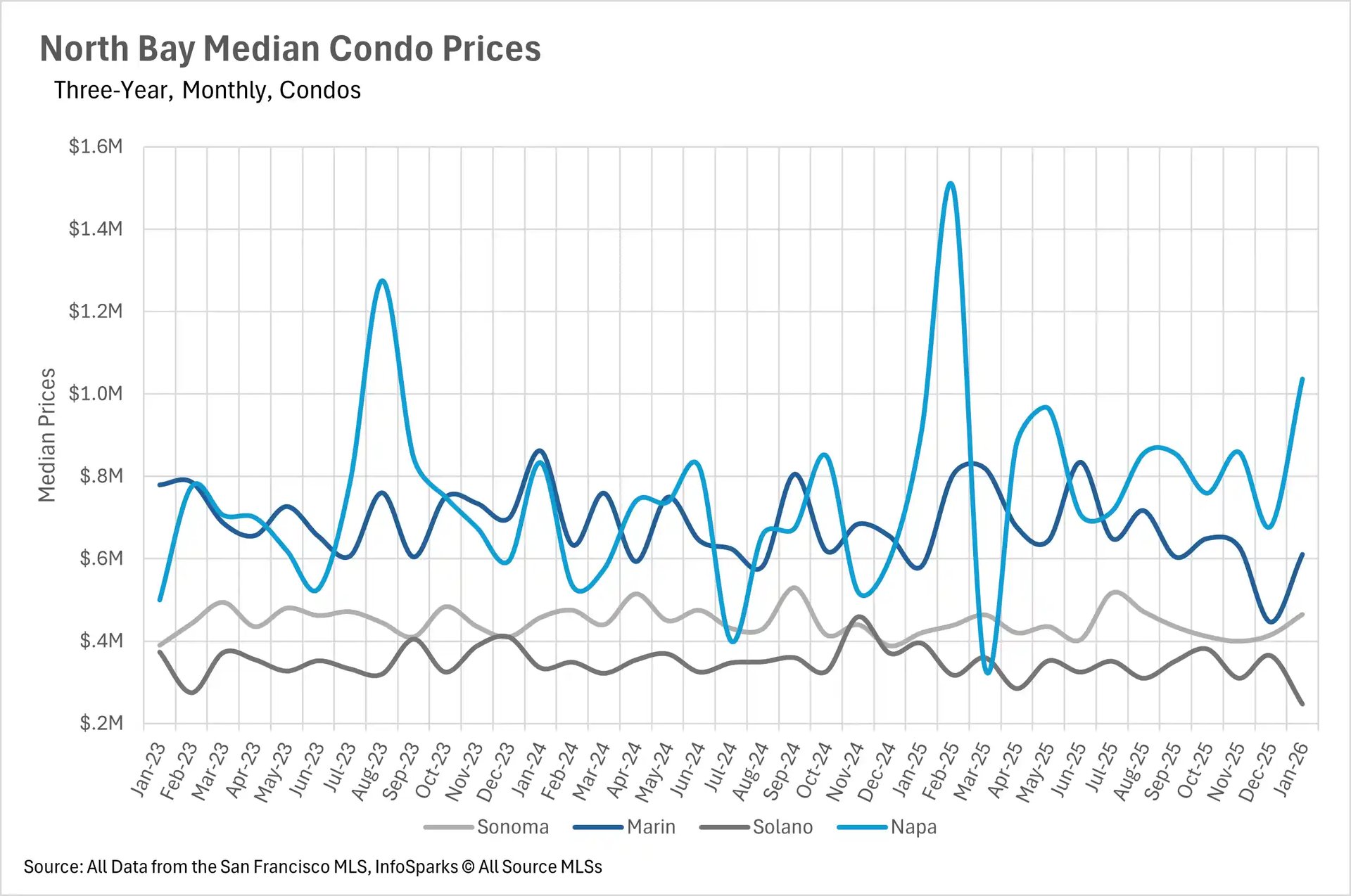
Line graph showing North Bay Median Condo Prices from January 2023 to January 2026. The chart compares Sonoma, Marin, Solano, and Napa counties. Napa shows extreme price volatility with massive spikes over $1.4 million, while Marin remains relatively stable between $600k and $800k. Solano and Sonoma are the most affordable, hovering between $300k and $500k.

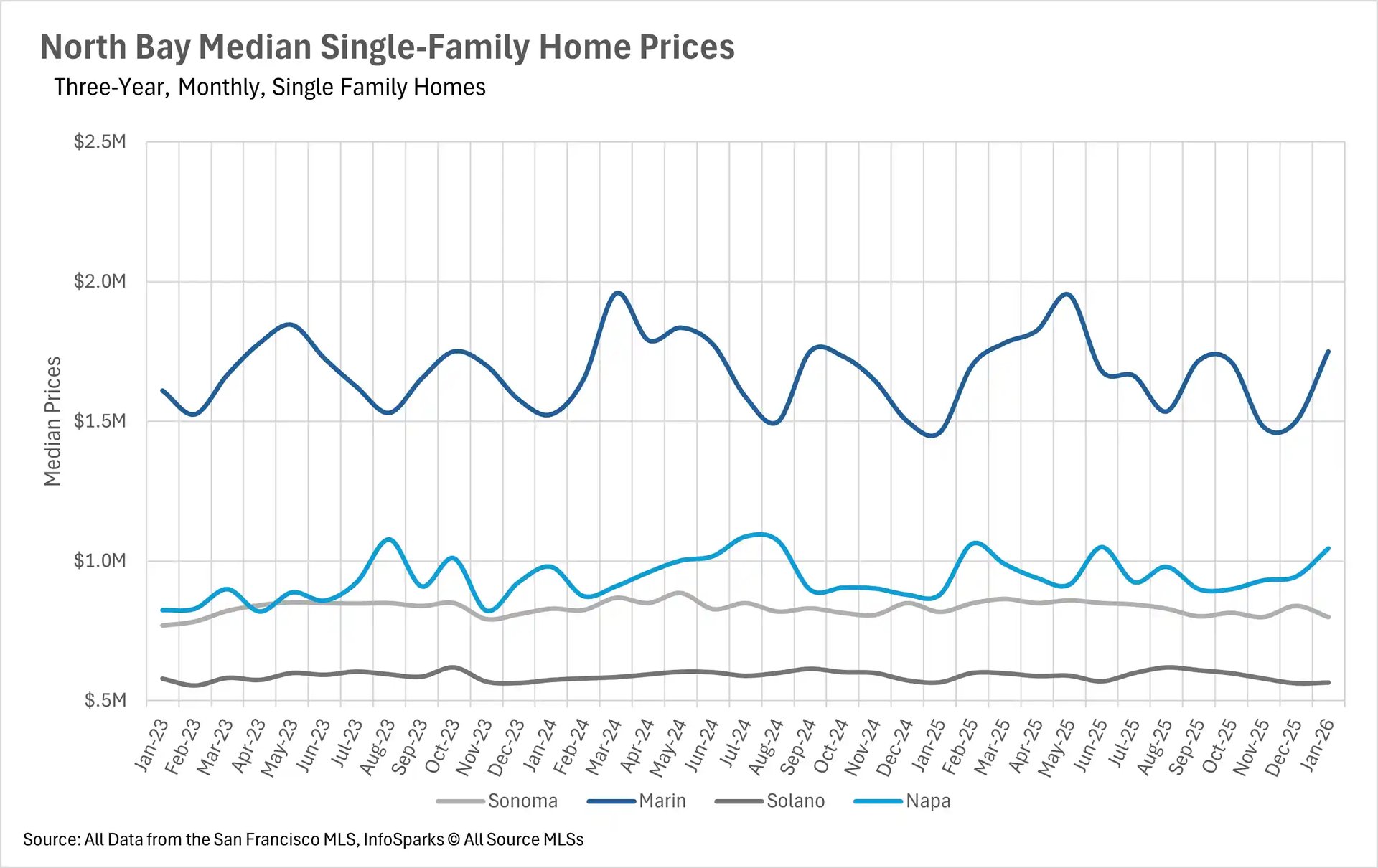
Line graph displaying three years of North Bay Median Single-Family Home Prices from January 2023 to January 2026. Marin County tracks significantly higher than the rest, fluctuating between $1.5 million and $2.0 million. Napa follows near $1.0 million, with Sonoma and Solano maintaining lower, stable price points.

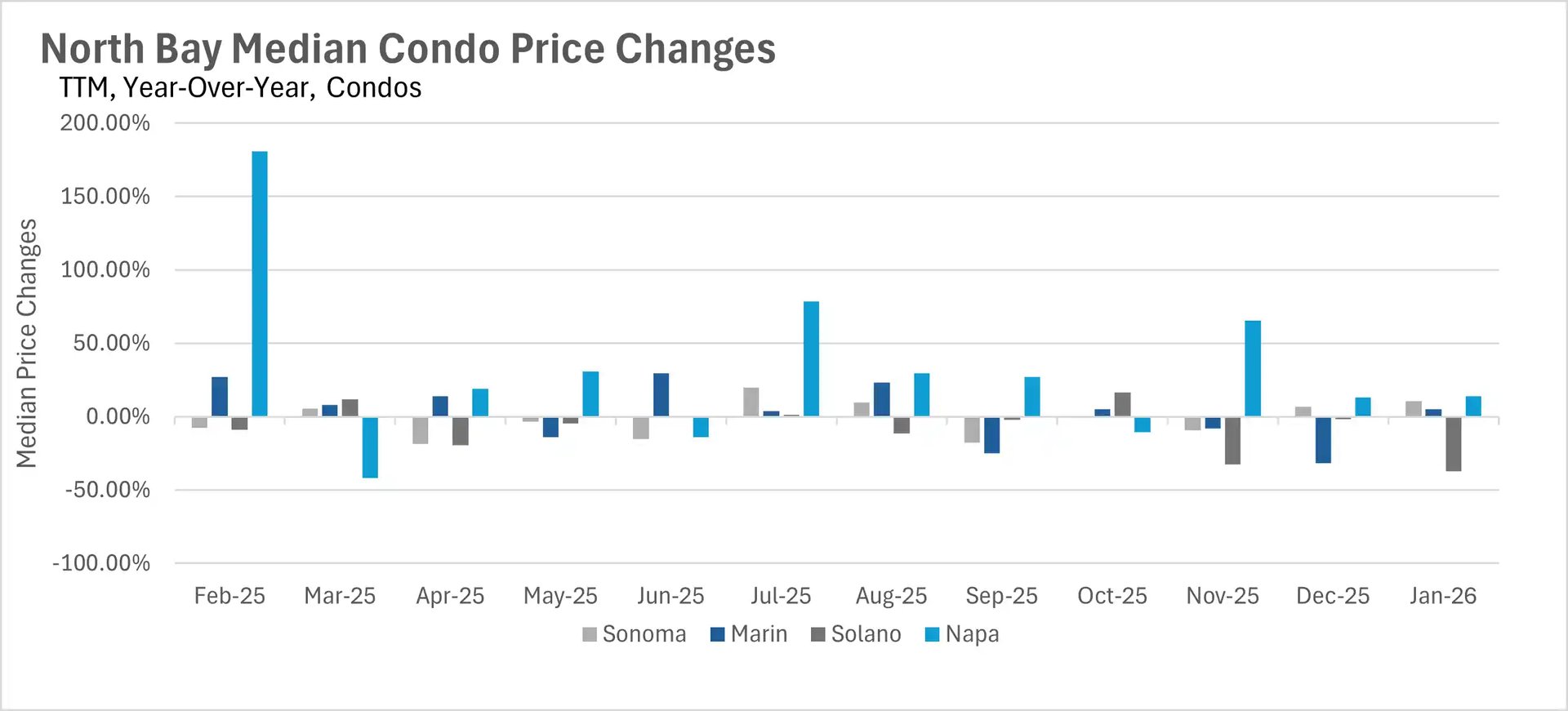
Bar chart illustrating Year-Over-Year Median Condo Price Changes in the North Bay from February 2025 to January 2026. The data highlights severe volatility in Napa County, which sees massive positive percentage spikes, while Sonoma, Marin, and Solano show more moderate, fluctuating price changes.

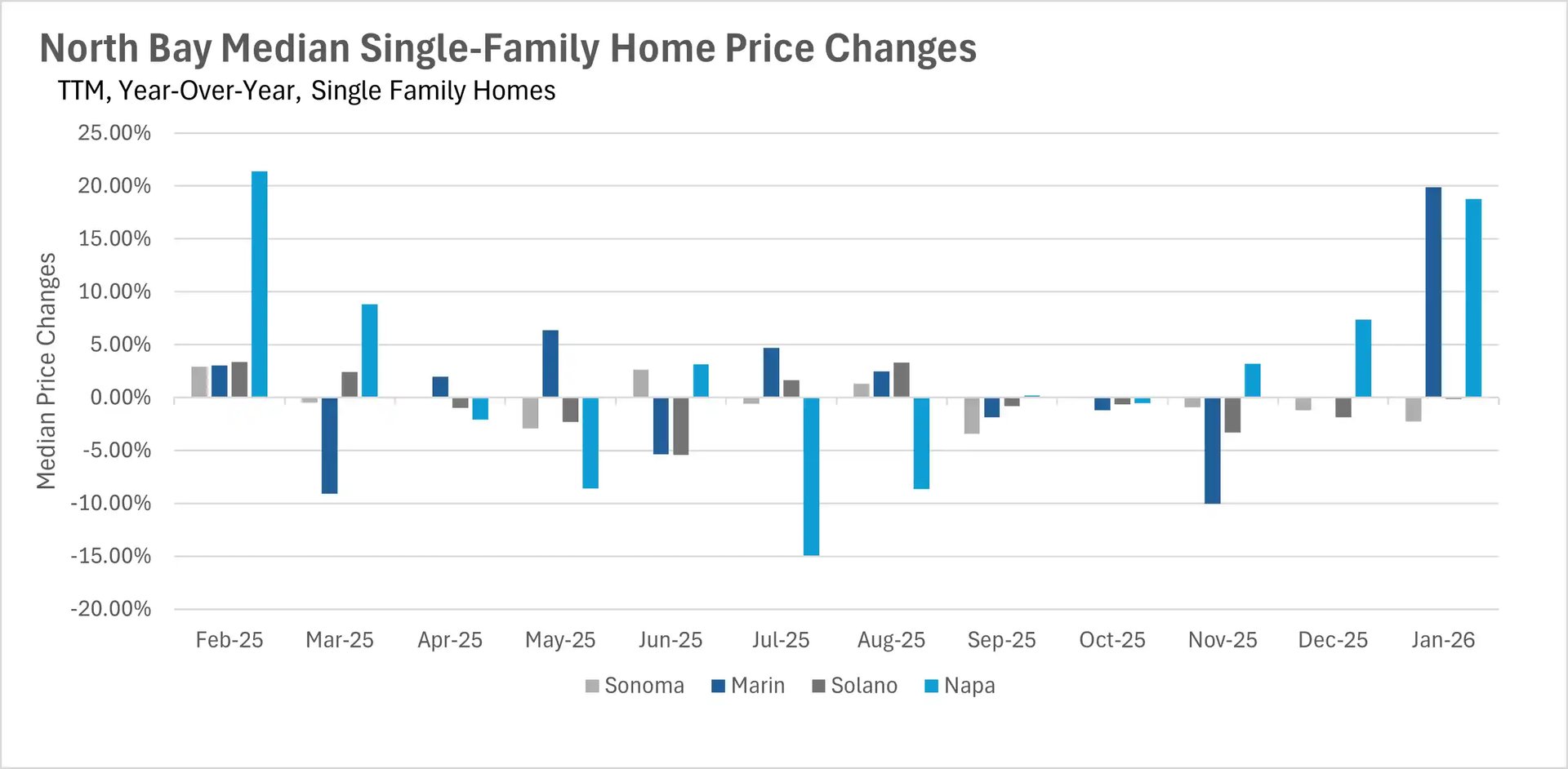
Bar chart showing Year-Over-Year Median Single-Family Home Price Changes in the North Bay from February 2025 to January 2026. Napa and Marin counties show notable double-digit percentage gains in early 2025 and January 2026, while Sonoma and Solano experience relatively flat or slightly negative changes.

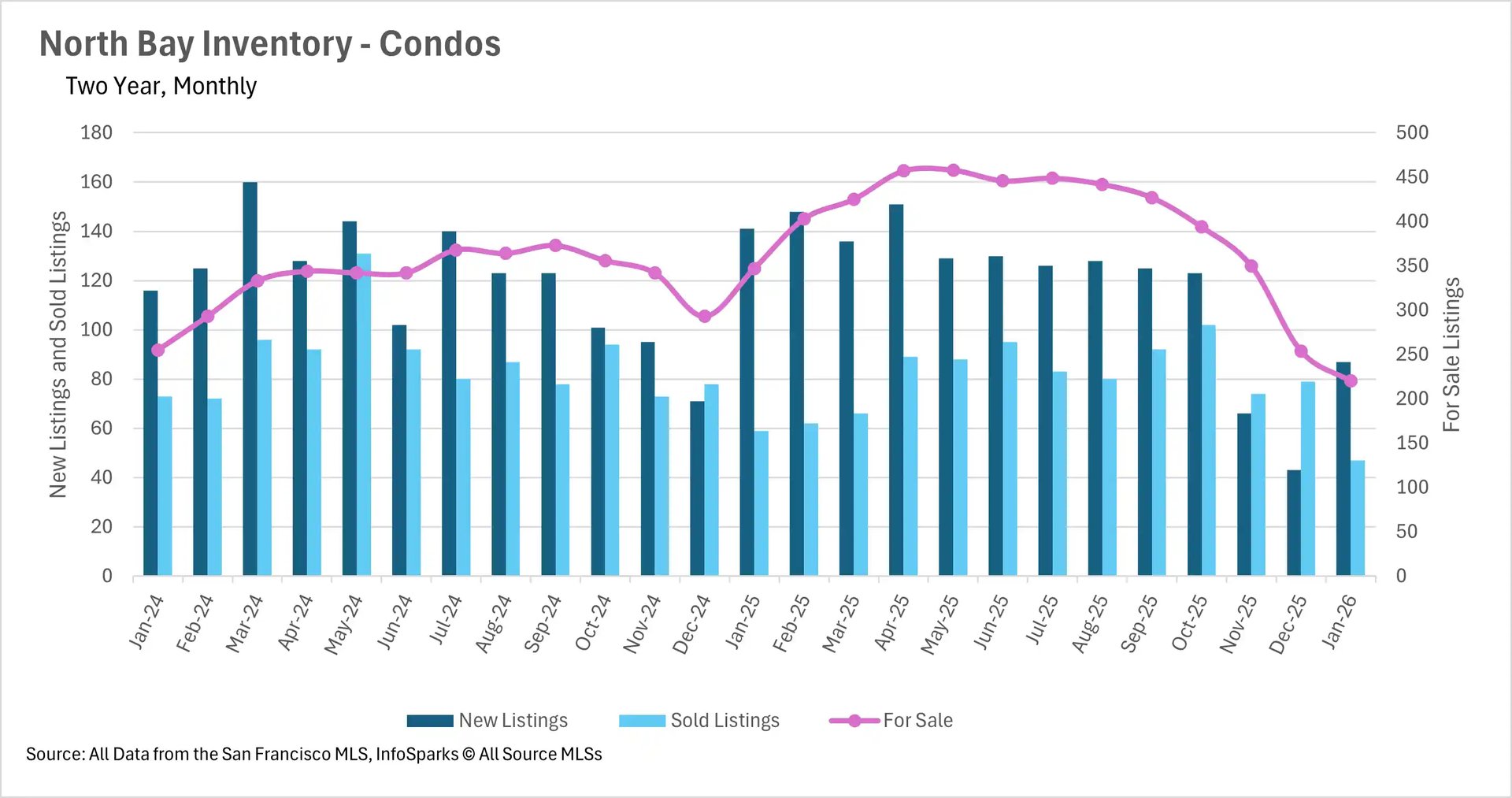
Combination bar and line chart showing North Bay Condo Inventory from January 2024 to January 2026. Blue bars indicate New and Sold listings, while a pink line tracks total For Sale inventory, highlighting a seasonal peak in the spring and summer of 2025 where active listings approach 450 units.

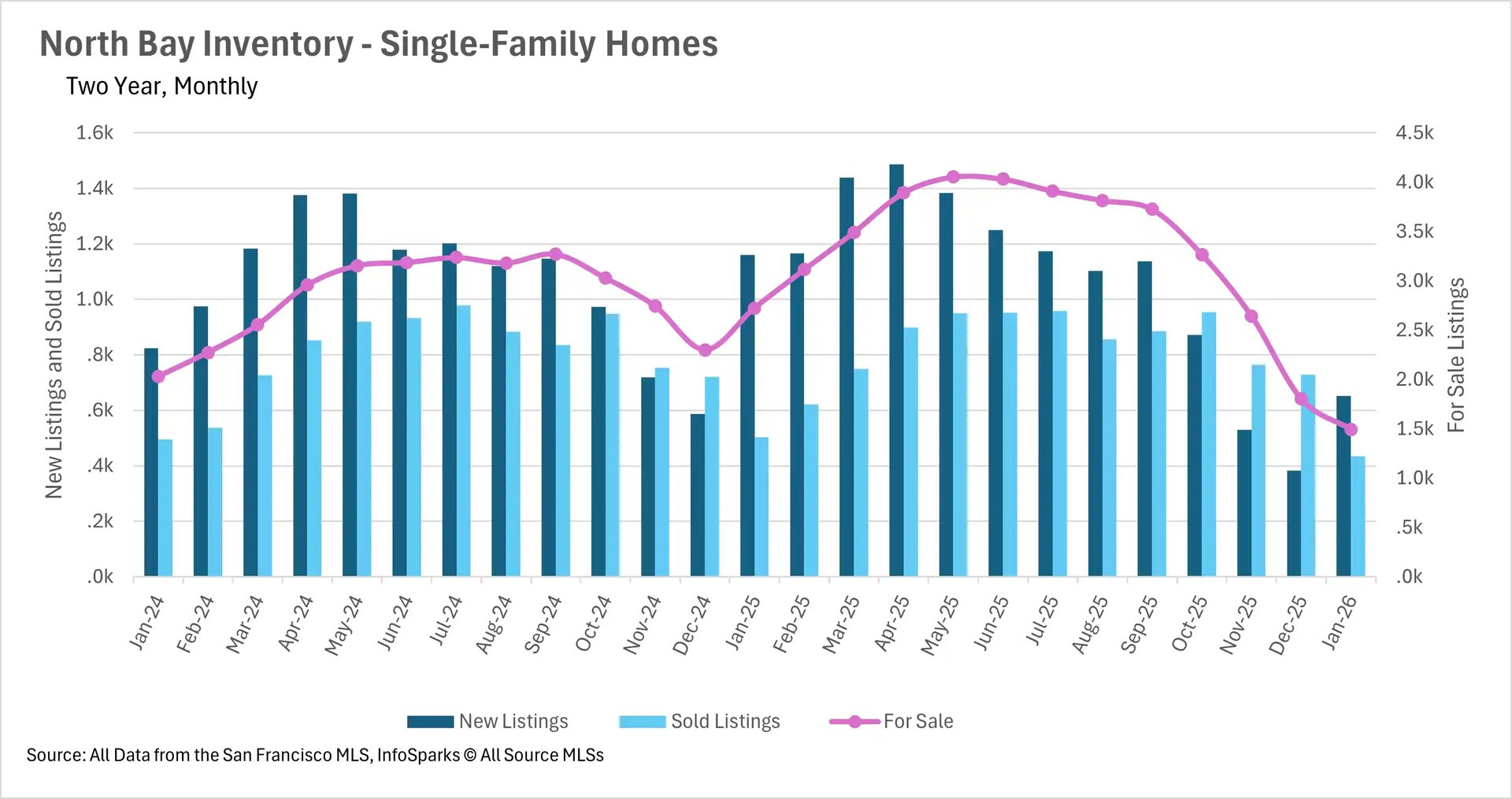
Combination chart displaying North Bay Single-Family Home Inventory from January 2024 to January 2026. The graph illustrates distinct seasonal trends, with total active inventory peaking at over 4,000 homes during the mid-year months of 2025 before declining sharply in the winter.

Line graph tracking Months of Supply Inventory for Condos in the North Bay from January 2024 to January 2026. Napa County shows a massive surplus, peaking over 9 months of supply in mid-2025, while Marin, Sonoma, and Solano generally trend between 3 and 6 months of supply.

Line graph showing North Bay Months of Supply Inventory for Single-Family Homes from January 2024 to January 2026. All counties exhibit a peak in supply during the summer of 2025—with Napa reaching 9 months—before declining sharply toward a tighter seller's market by January 2026.

Line graph depicting Days on Market for Condos in the North Bay from January 2024 to January 2026. Napa County sell times are highly erratic, with massive spikes reaching nearly 200 days, while the other counties generally fluctuate between 25 and 75 days on the market.

A wide-angle landscape photograph of a large, single-story house with green roofing and stucco walls, situated on an expansive green lawn. A paved driveway leads to a garage on the left side of the house. Palm trees and various tropical plants dot the landscape, with lush, green hills visible in the background under a partly cloudy blue sky.

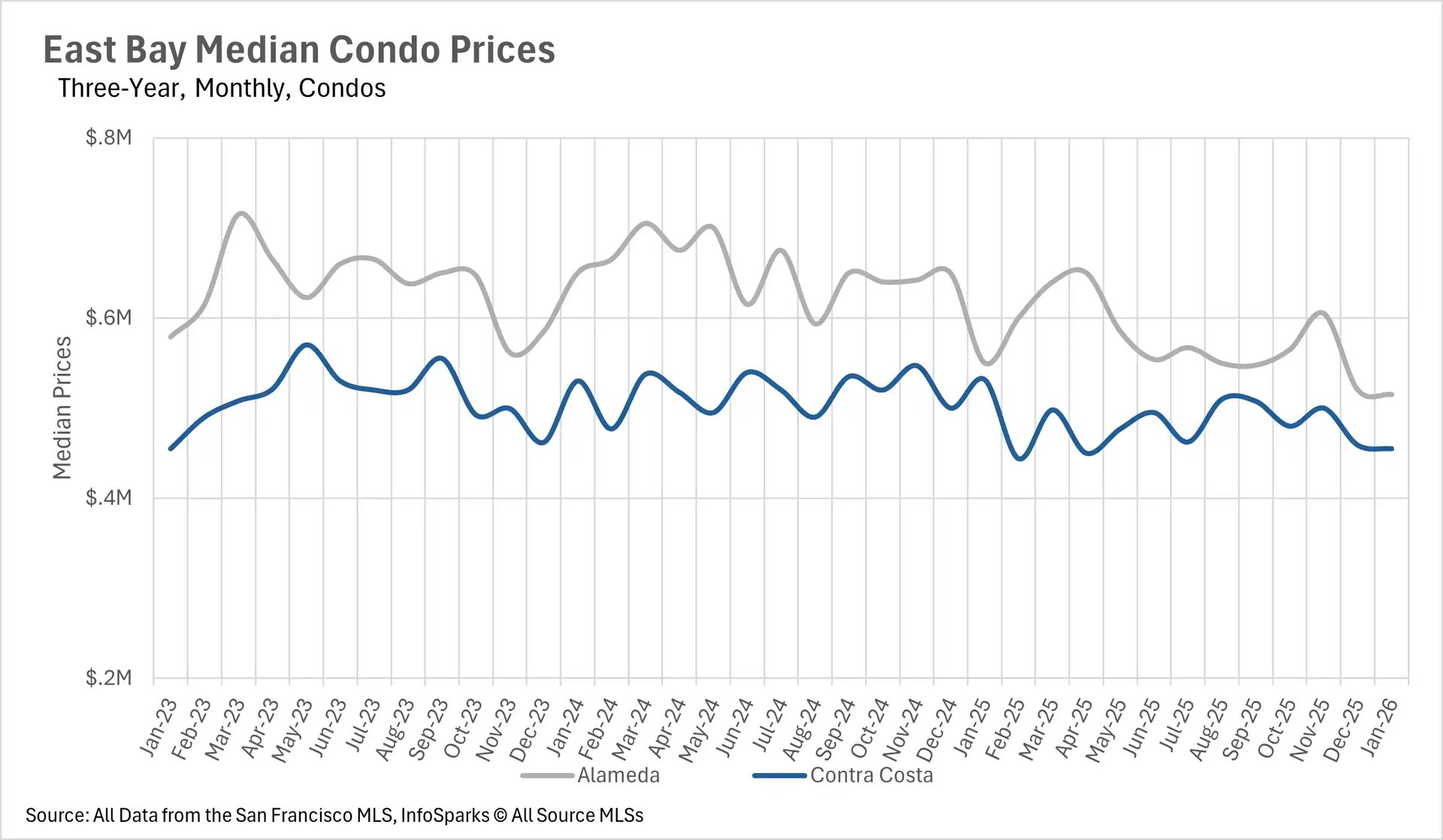
Line graph showing East Bay Median Condo Prices from January 2023 to January 2026. The chart compares Alameda and Contra Costa counties, with Alameda consistently showing higher median prices generally ranging between $600k and $700k, while Contra Costa hovers closer to $500k.

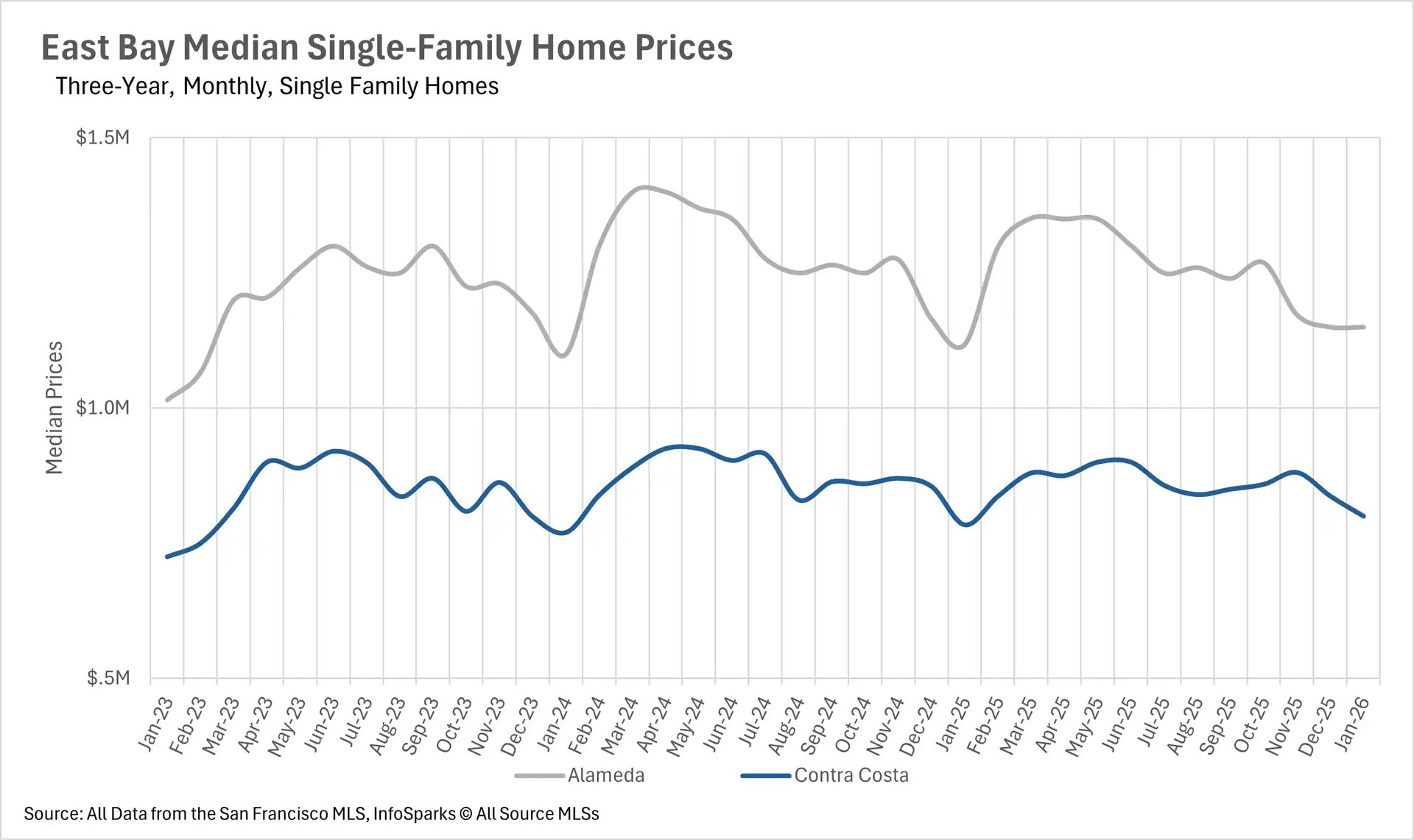
Line graph displaying three years of East Bay Median Single-Family Home Prices from January 2023 to January 2026. Alameda County tracks higher, frequently exceeding $1.2 million, while Contra Costa County remains lower, fluctuating roughly between $800k and $900k.

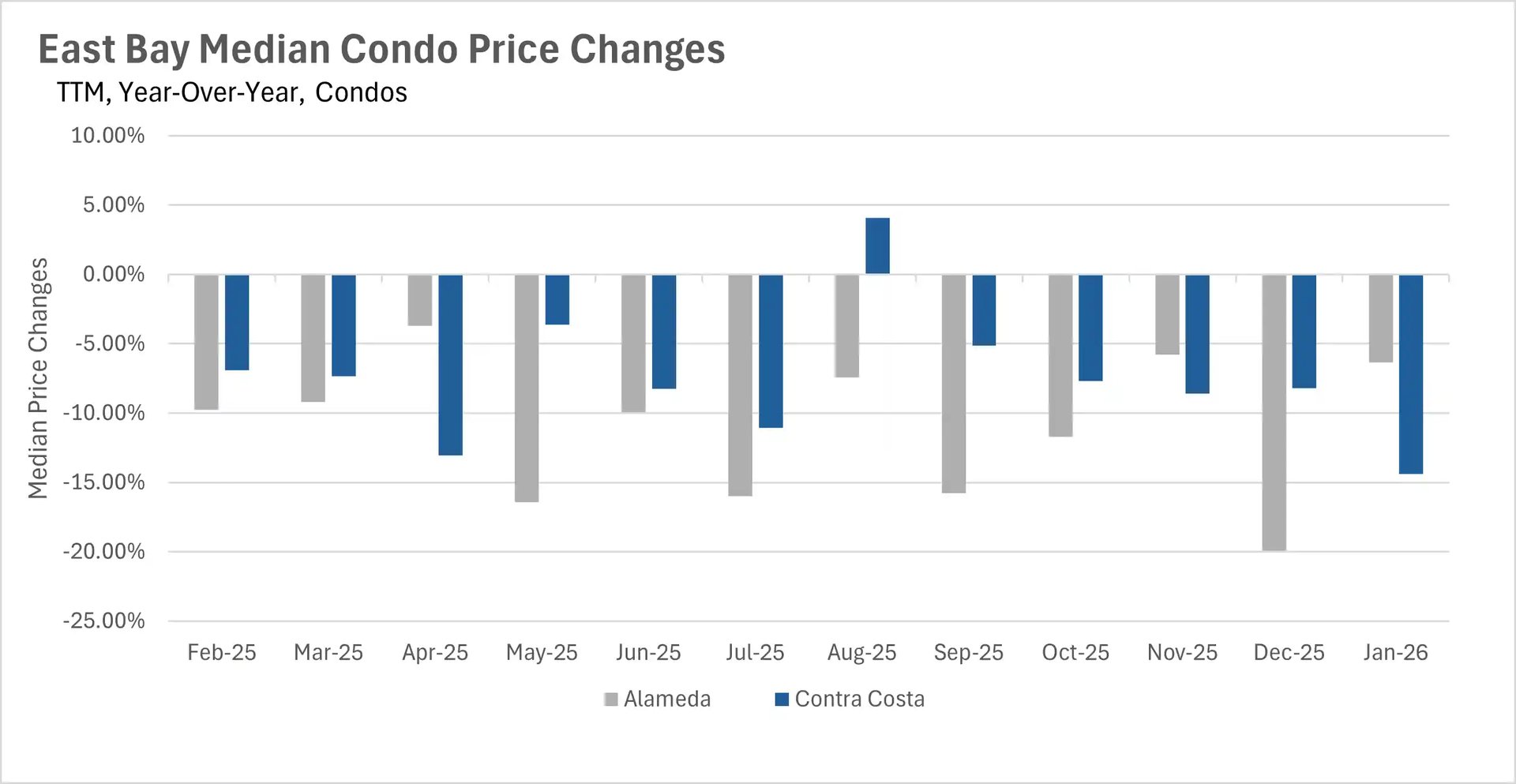
Bar chart illustrating Year-Over-Year Median Condo Price Changes in the East Bay from February 2025 to January 2026. The data shows mostly negative price changes for both Alameda and Contra Costa counties during this period, with several months seeing price declines of 10% or more.

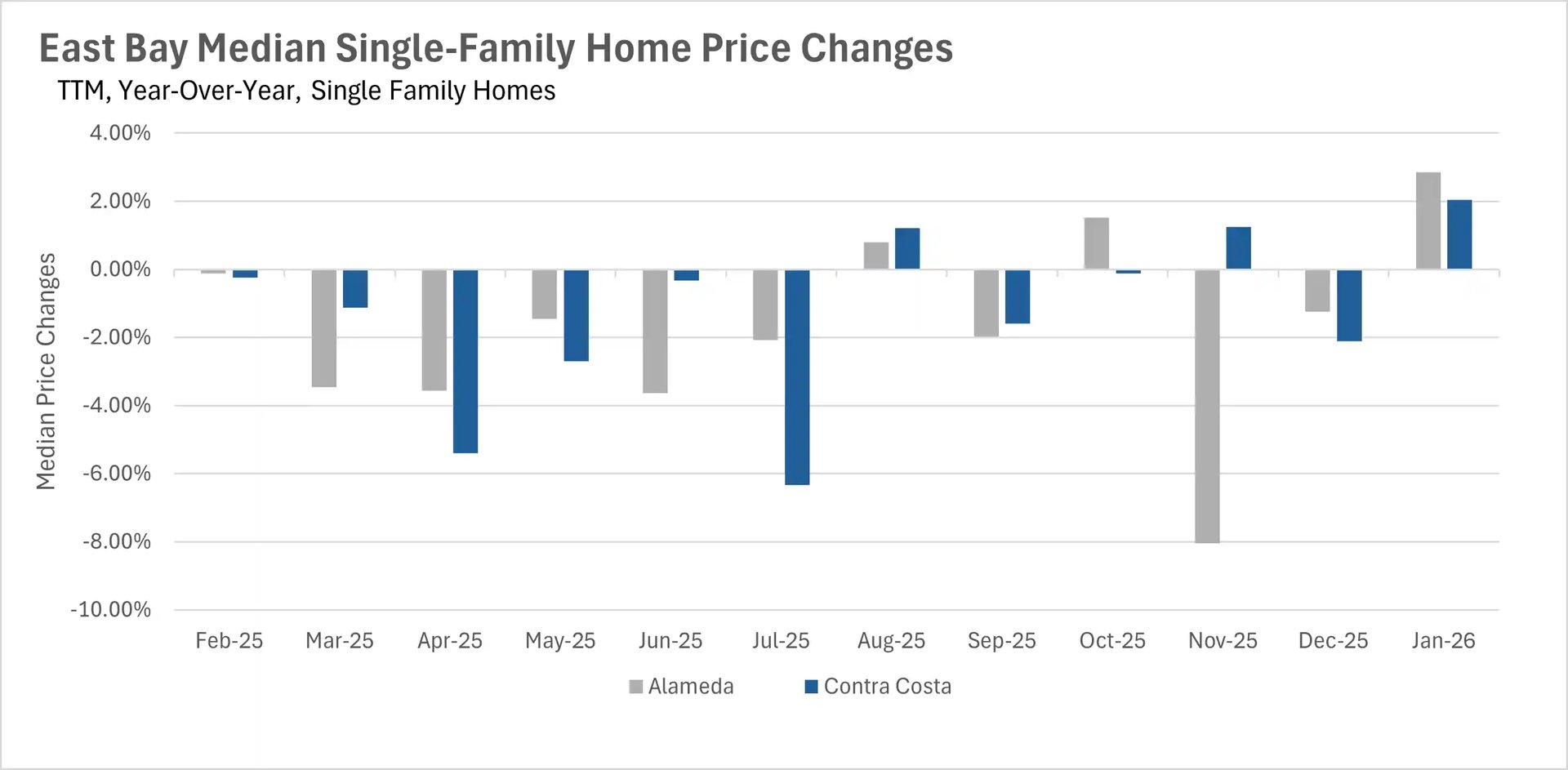
Bar chart showing Year-Over-Year Median Single-Family Home Price Changes in the East Bay from February 2025 to January 2026. Price changes fluctuate for Alameda and Contra Costa counties, with notable percentage drops in spring and late fall, followed by a positive rebound for both counties in January 2026.

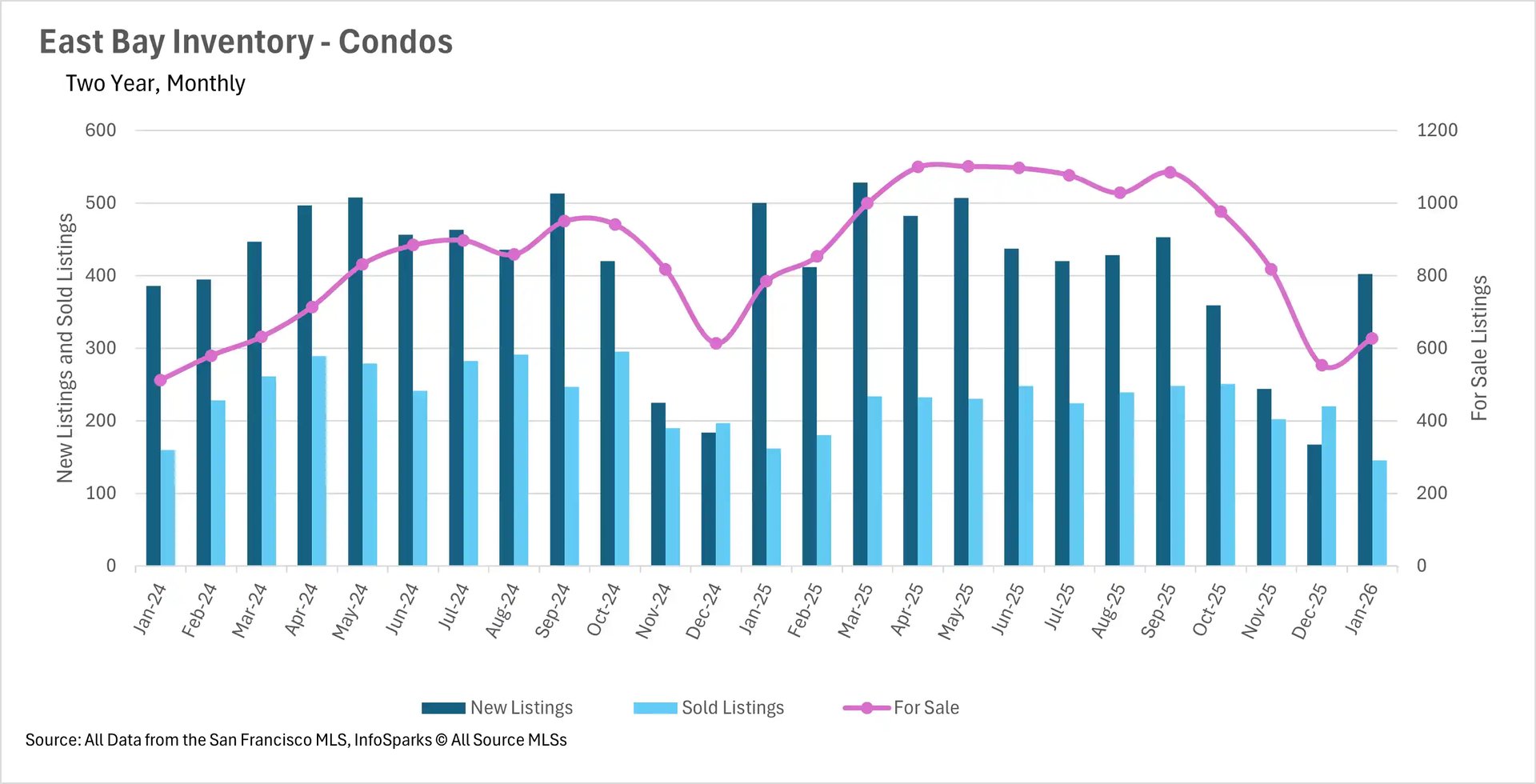
Combination bar and line chart showing East Bay Condo Inventory from January 2024 to January 2026. Blue bars indicate New and Sold listings, while a pink line tracks total For Sale inventory, highlighting a clear seasonal peak in the spring and summer months where active listings approach 1,000 units.

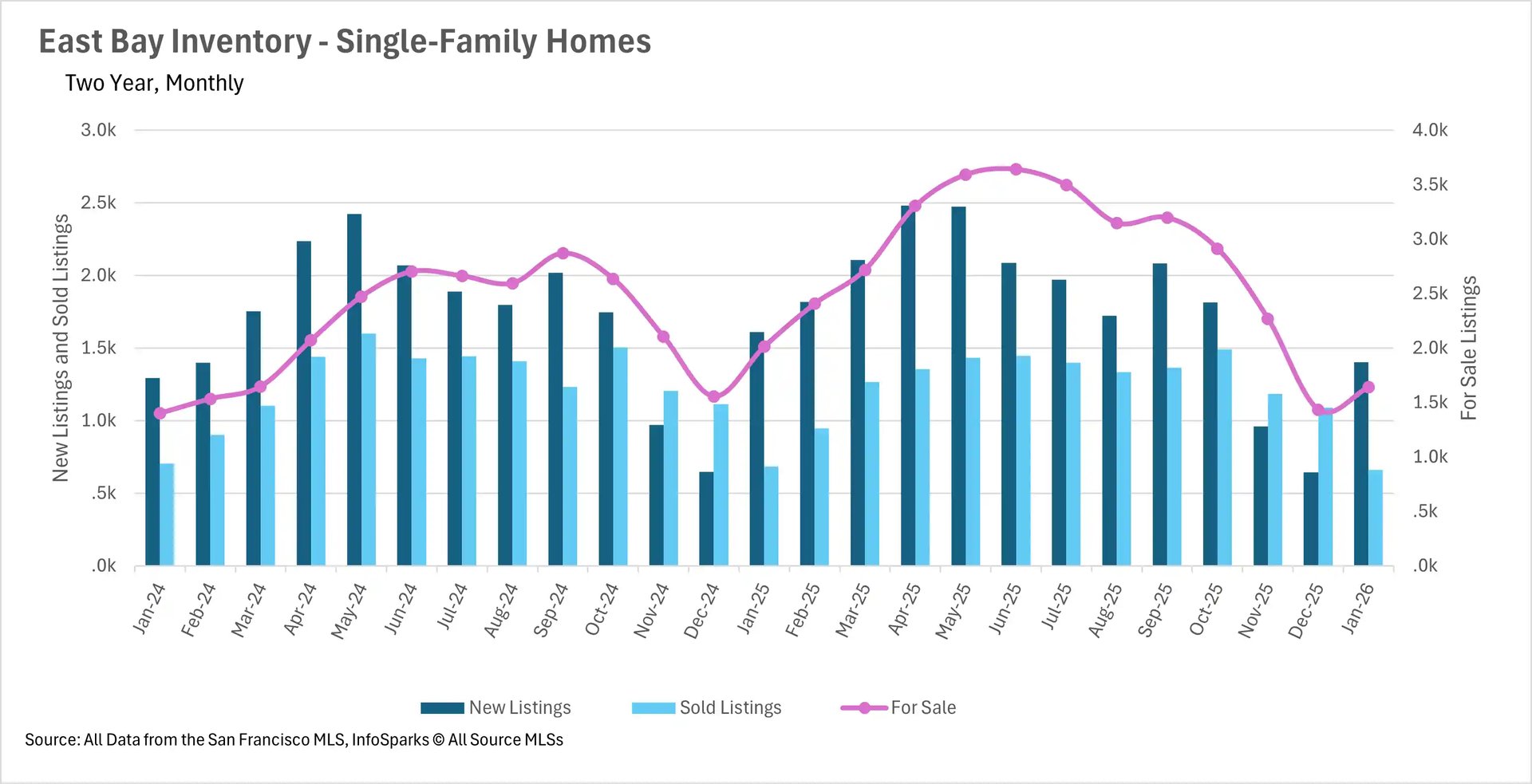
Combination chart displaying East Bay Single-Family Home Inventory from January 2024 to January 2026. The graph illustrates seasonal trends for New Listings, Sold Listings, and For Sale properties, with total active inventory peaking above 3,500 homes during the mid-year months.
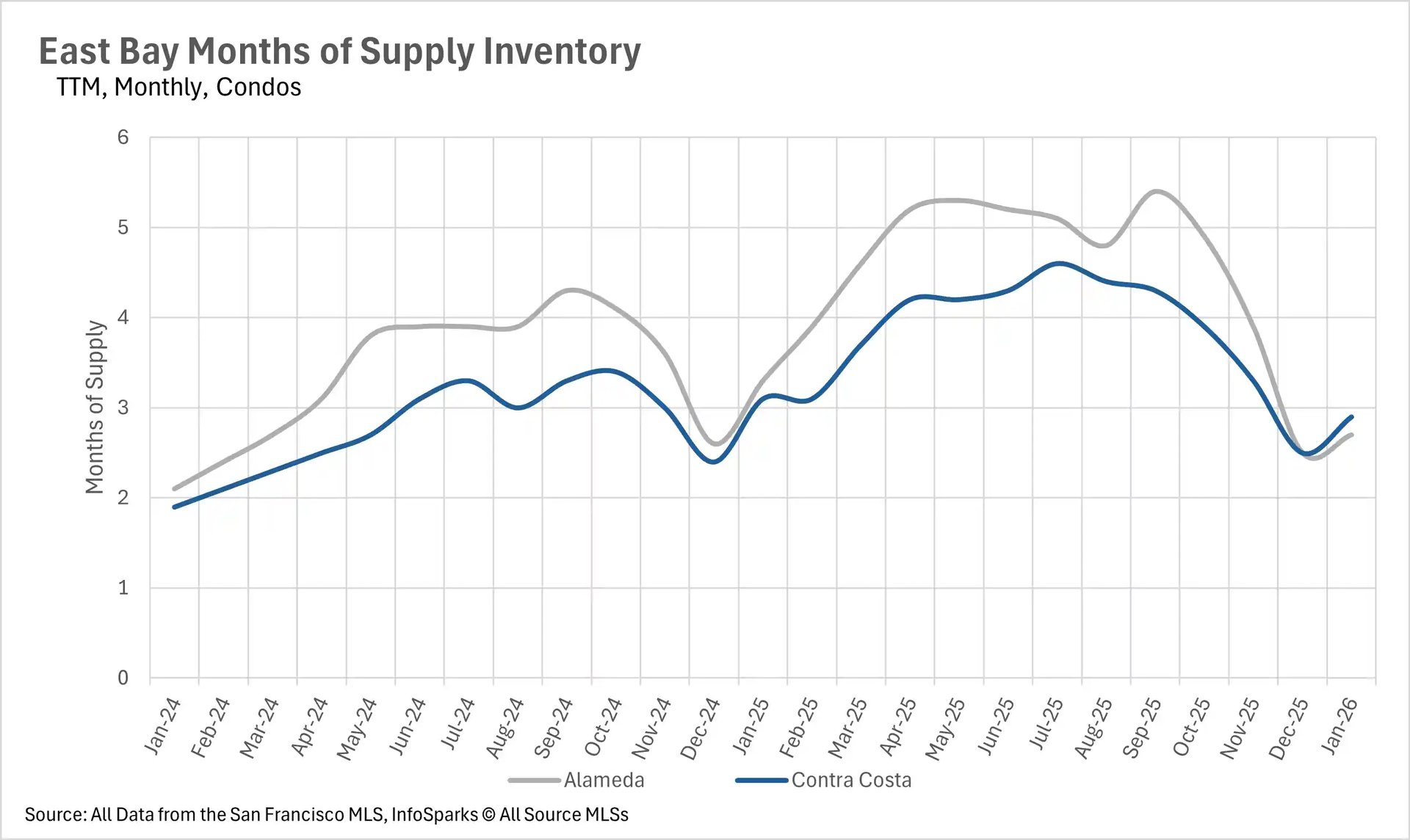
Line graph tracking Months of Supply Inventory for Condos in the East Bay from January 2024 to January 2026. Alameda County generally shows a slightly higher supply, peaking near 5.5 months in late 2025, while Contra Costa tracks closely behind, peaking around 4.5 months.
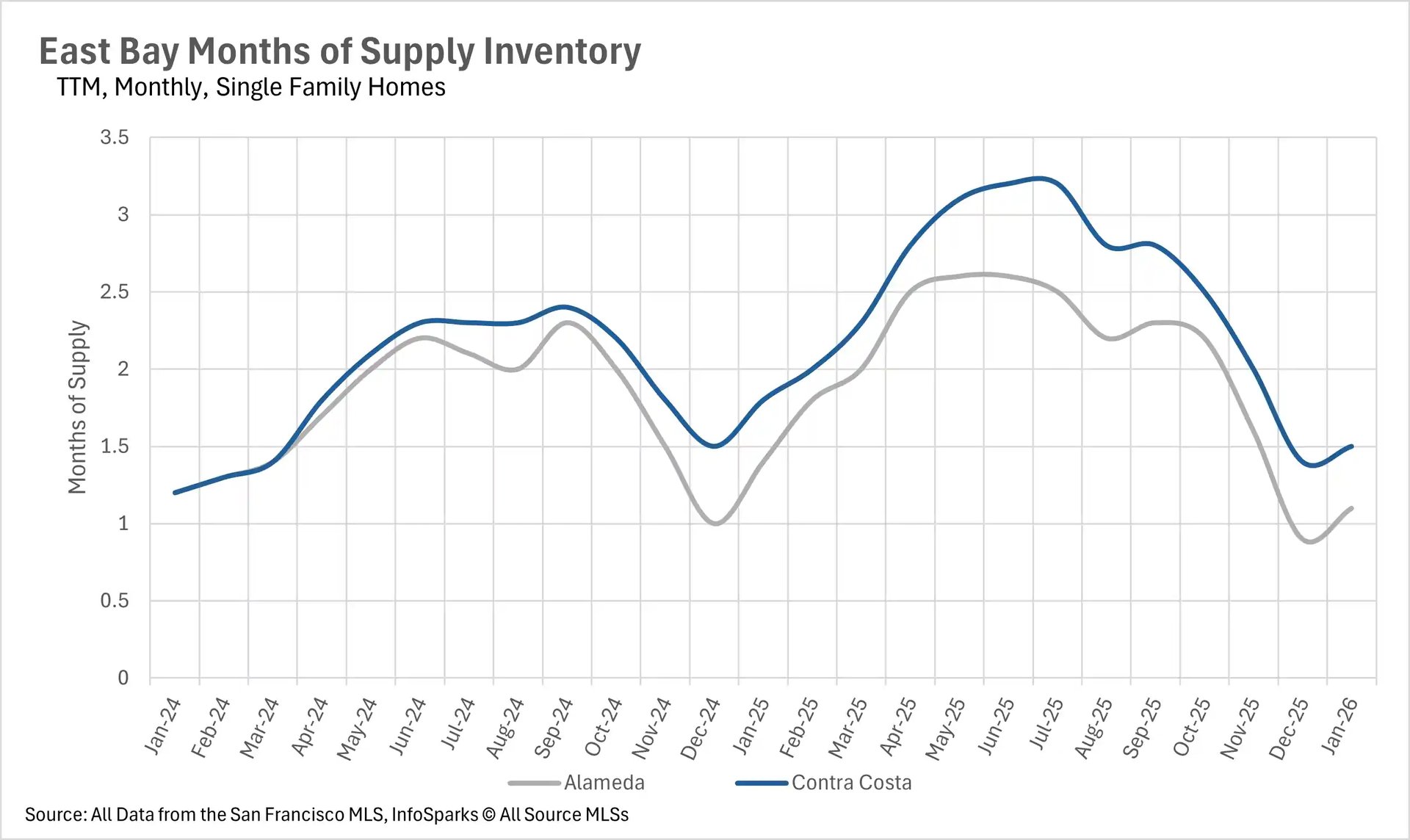
Line graph showing East Bay Months of Supply Inventory for Single-Family Homes from January 2024 to January 2026. Both Alameda and Contra Costa counties exhibit seasonal peaks in the summer but mostly remain under 3.5 months of supply, indicating a persistent seller's market.

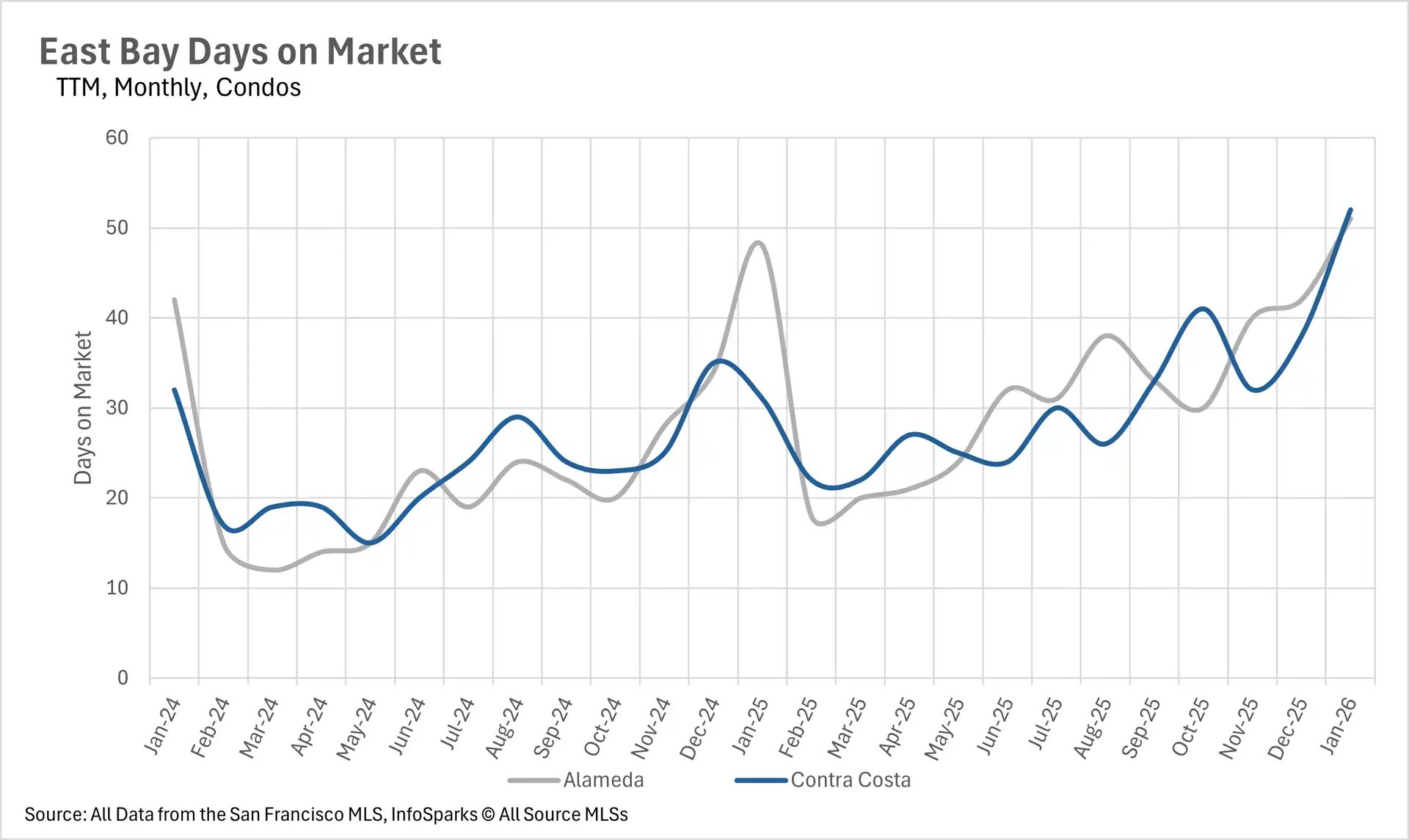
Line graph depicting Days on Market for Condos in the East Bay from January 2024 to January 2026. Sell times for both Alameda and Contra Costa counties show high volatility and a sharp upward trend heading into 2026, reaching over 40 and 50 days respectively.

Multi-story residential townhome building featuring modern red and beige exterior siding against a sunny blue sky.

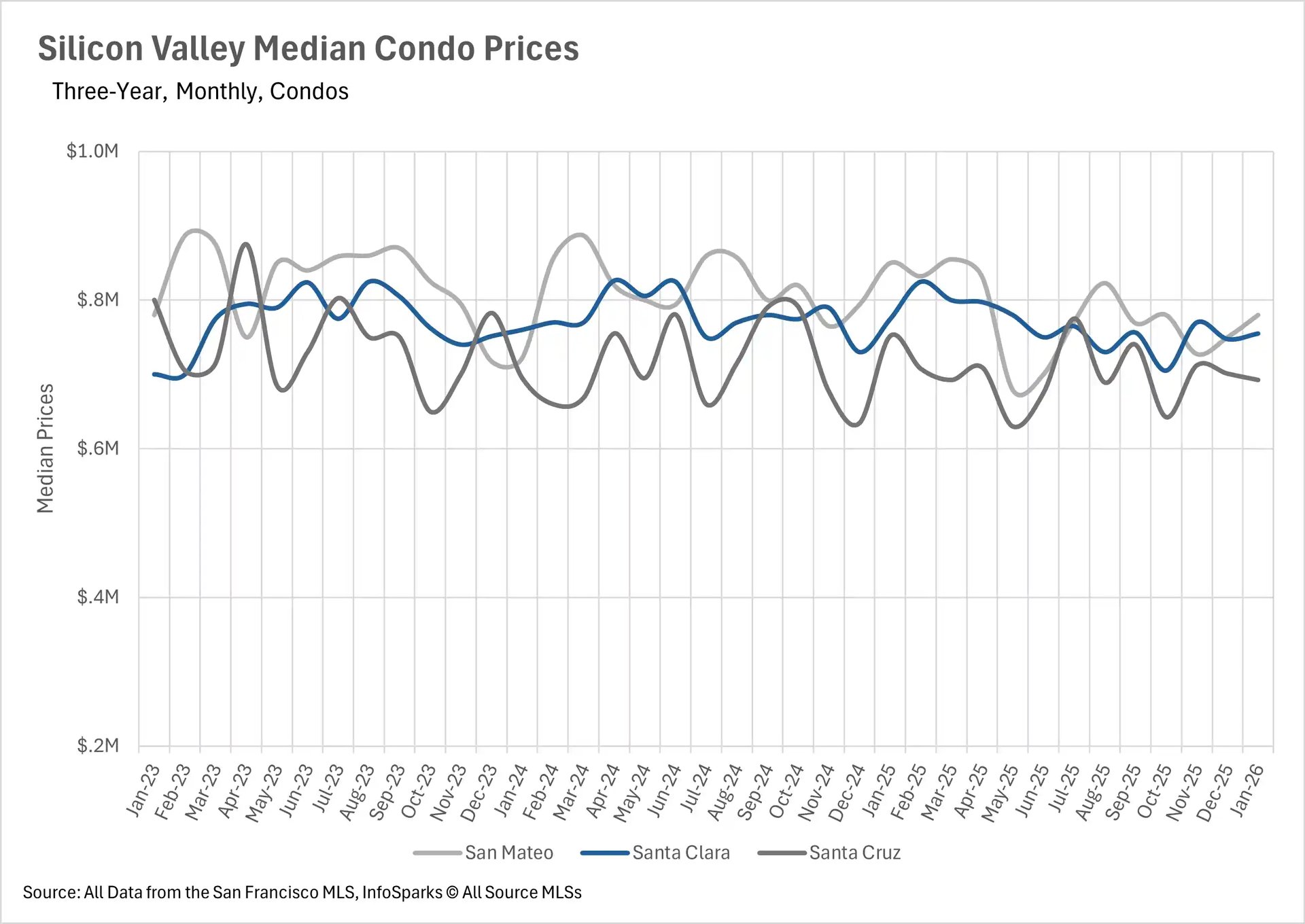
Line chart showing Silicon Valley median condo prices over a three-year period, comparing real estate trends in San Mateo, Santa Clara, and Santa Cruz counties.

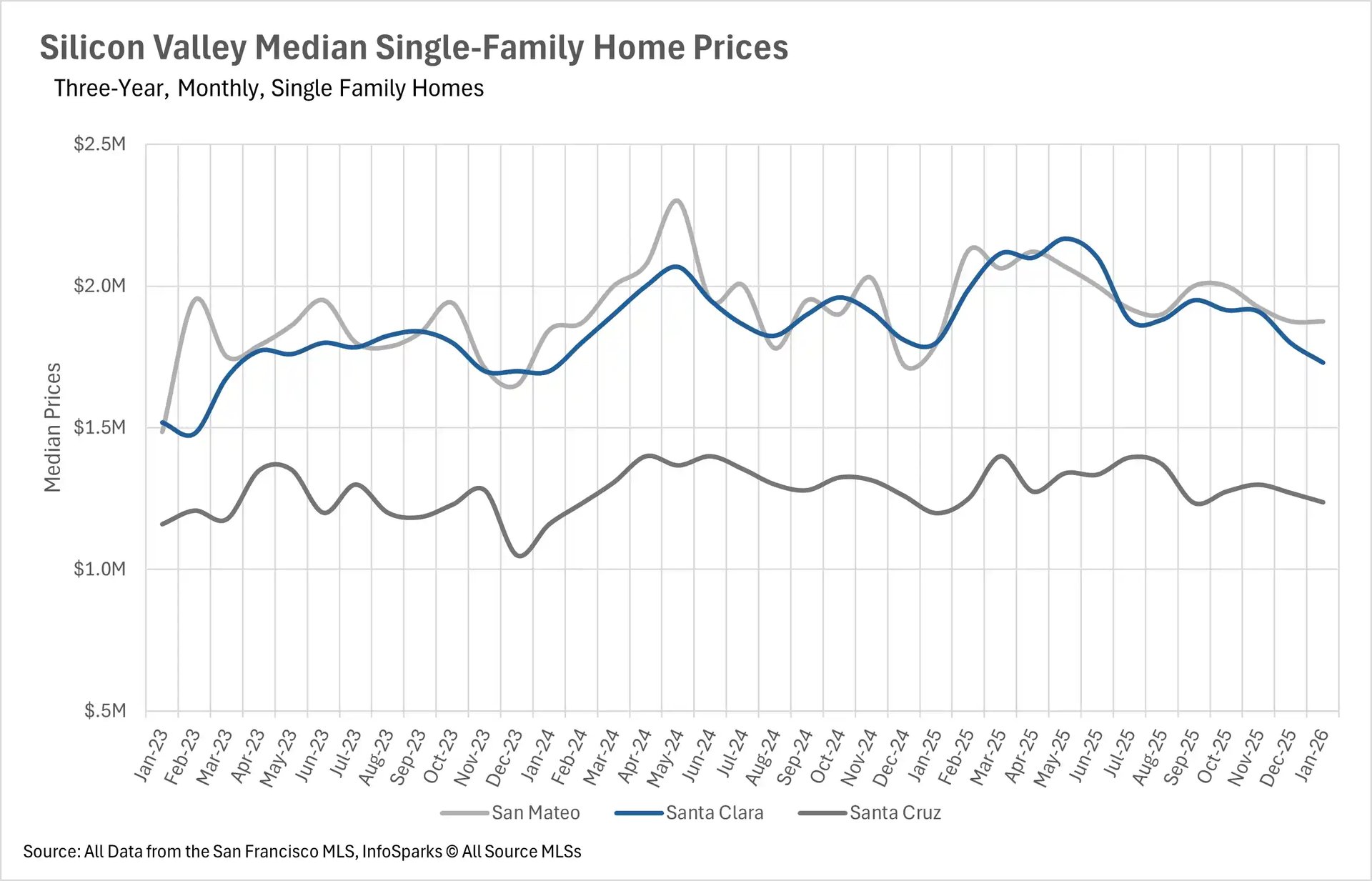
Line chart displaying Silicon Valley median single-family home prices over a three-year period, tracking values across San Mateo, Santa Clara, and Santa Cruz.

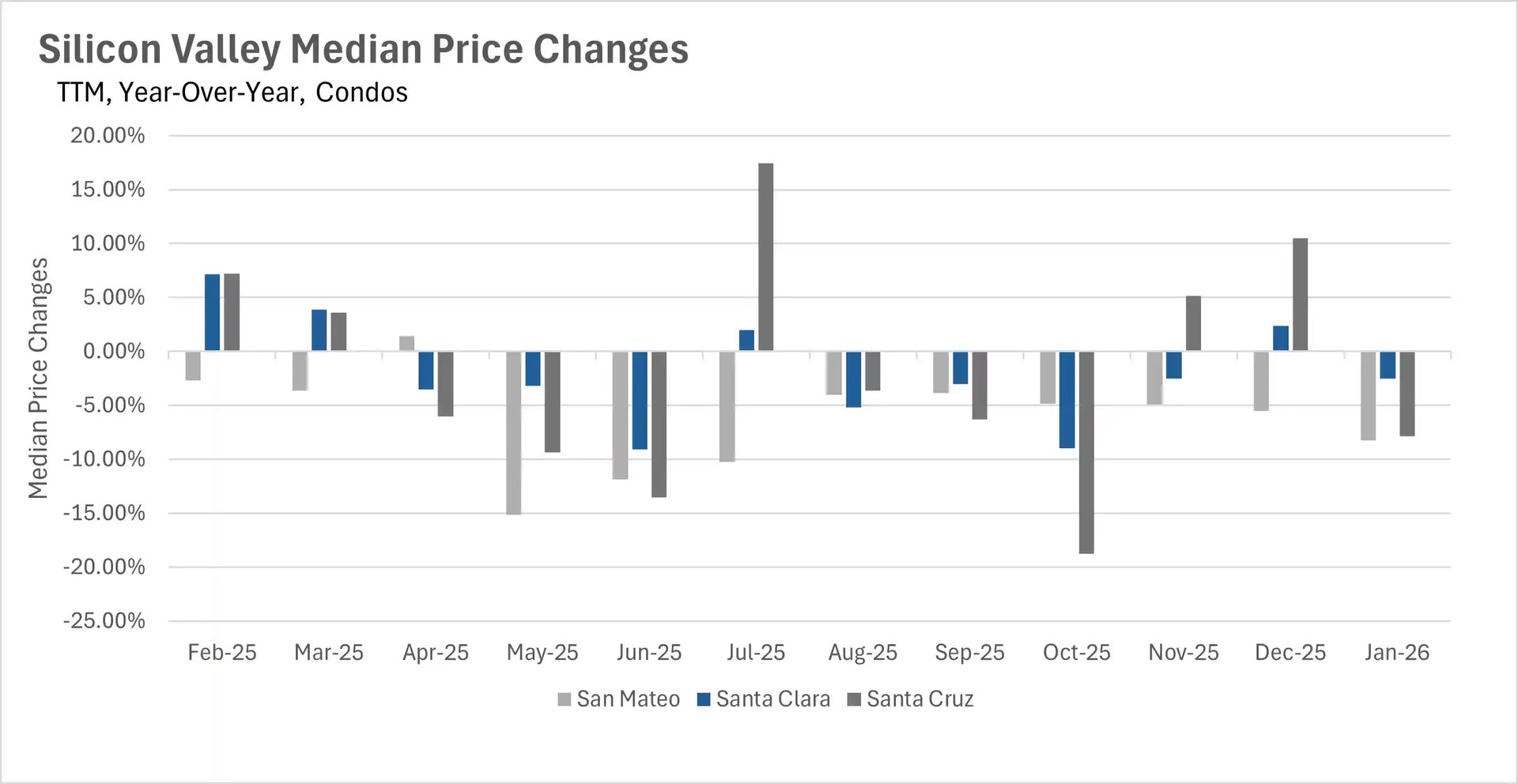
Bar chart illustrating year-over-year median condo price changes in Silicon Valley, comparing percentage fluctuations for San Mateo, Santa Clara, and Santa Cruz.

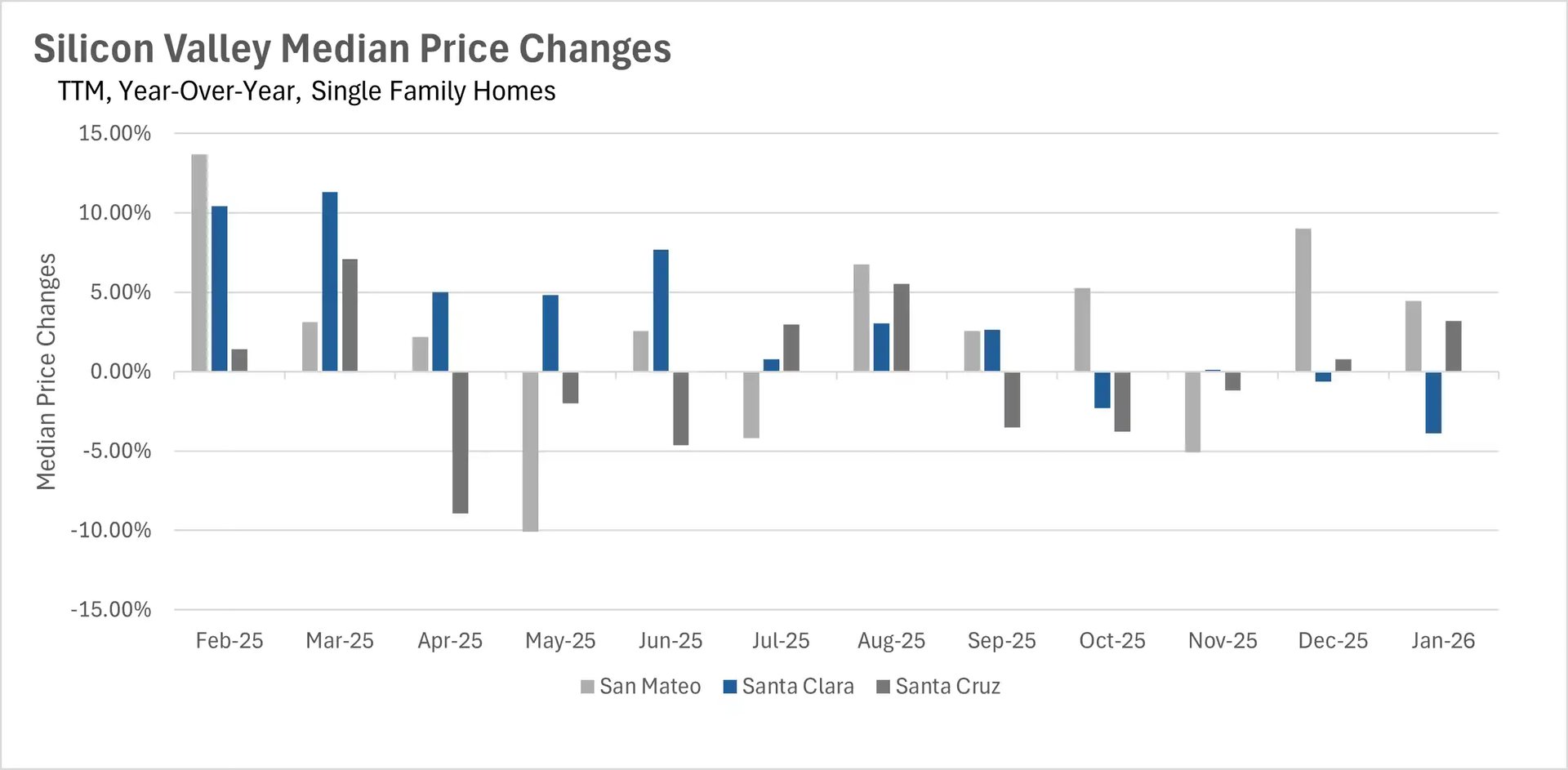
Bar chart showing year-over-year median single-family home price percentage changes for Silicon Valley real estate markets in San Mateo, Santa Clara, and Santa Cruz.

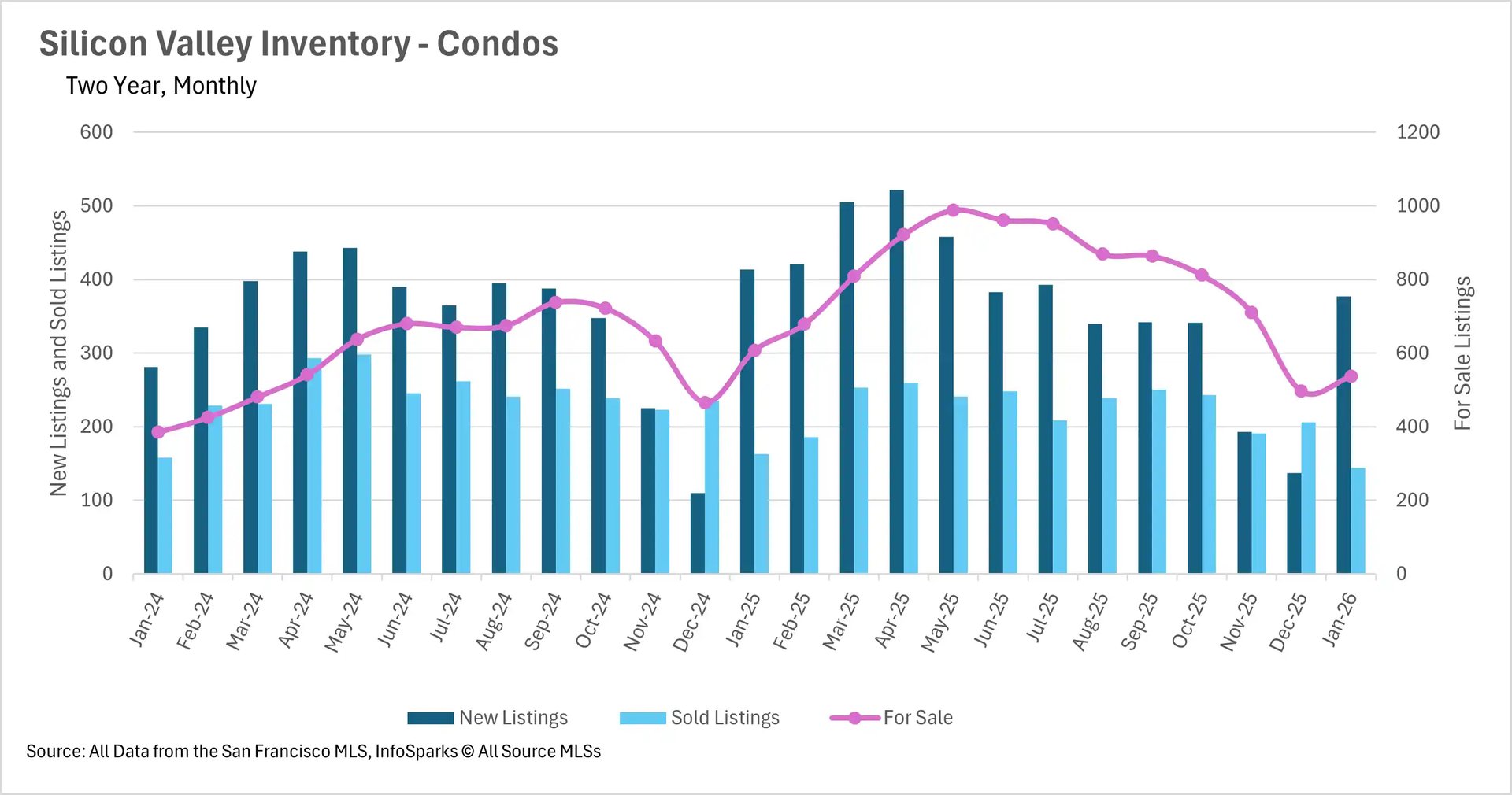
Combination chart tracking two-year monthly condo inventory in Silicon Valley, detailing the volume of new listings, sold listings, and total active homes for sale.

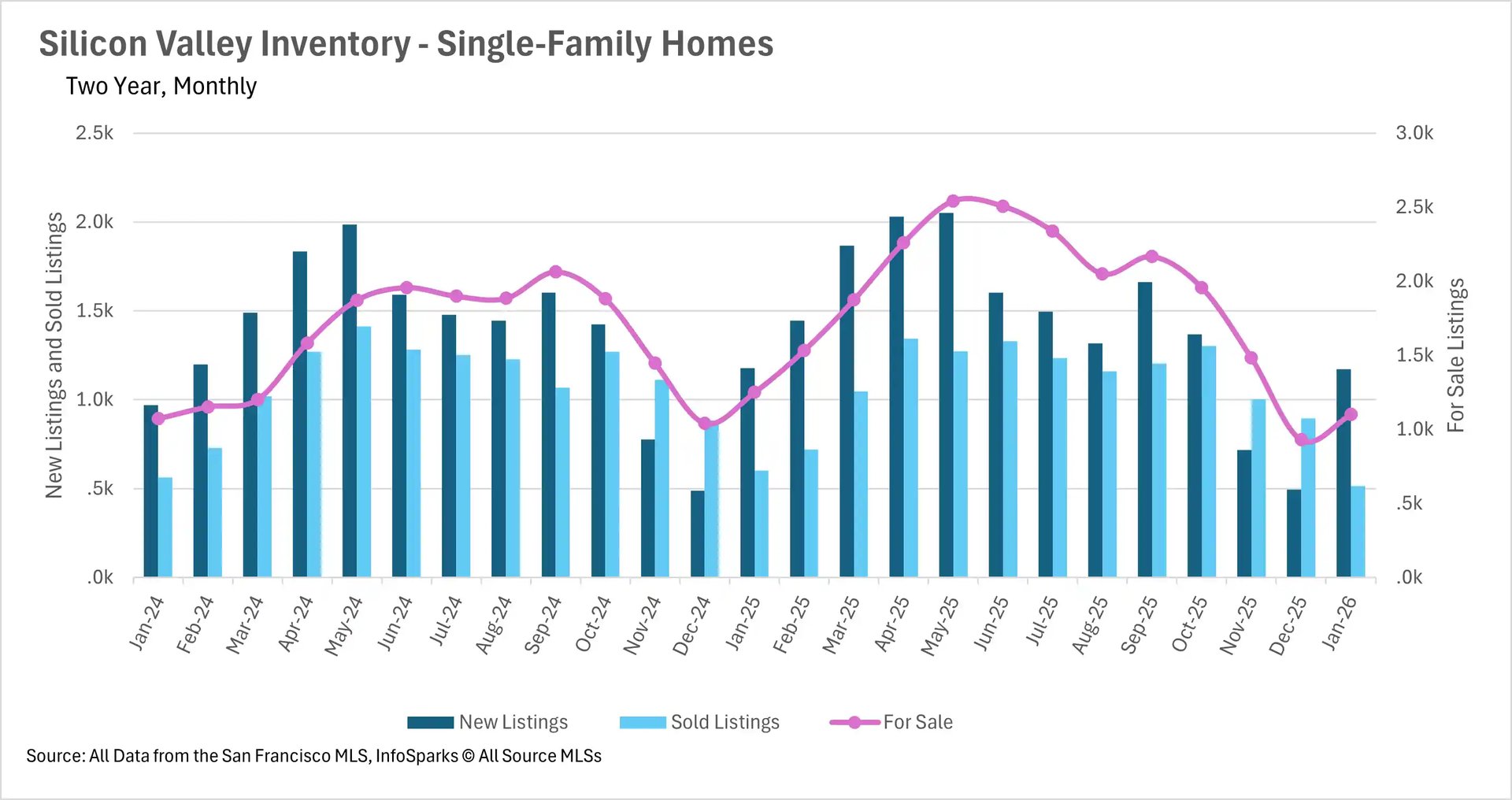
Combination chart tracking two-year monthly single-family home inventory in Silicon Valley, highlighting new listings, sold units, and total active housing supply.

Line graph depicting months of supply inventory for Silicon Valley condos, comparing market saturation in San Mateo, Santa Clara, and Santa Cruz.

Line graph showing months of supply housing inventory for Silicon Valley single-family homes across San Mateo, Santa Clara, and Santa Cruz.

Line graph tracking the average days on market for condos in Silicon Valley, comparing the speed of sales in San Mateo, Santa Clara, and Santa Cruz.

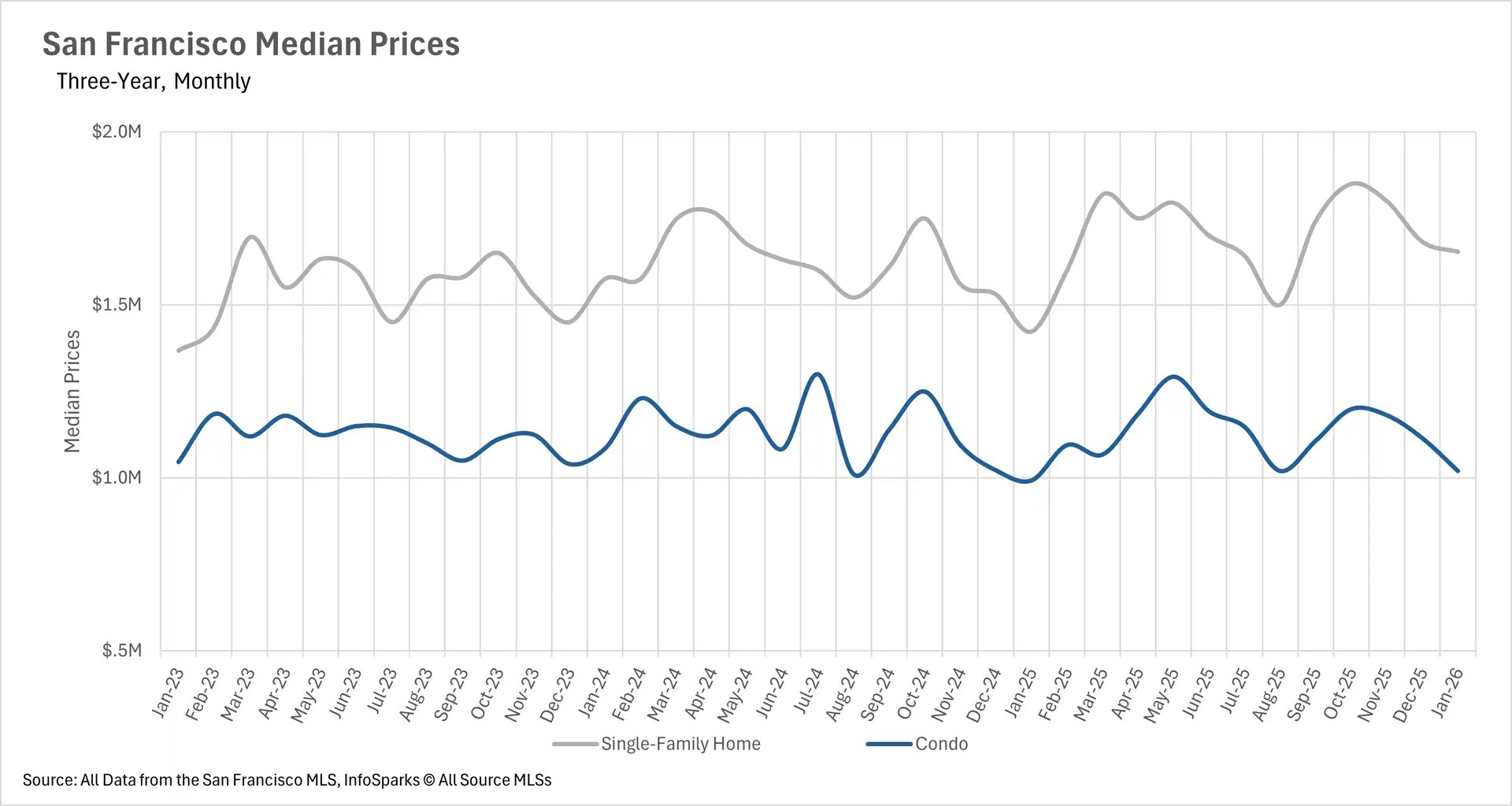
Line chart titled San Francisco Median Prices, Three-Year Monthly showing median sale prices from January 2023 to January 2026 for single-family homes (gray line) and condos (blue line). Single-family home prices fluctuate between approximately $1.4M and $1.85M with seasonal peaks each spring, ending around $1.7M in January 2026. Condo prices remain relatively flat, ranging from roughly $1.0M to $1.3M throughout the period. Source: San Francisco MLS, InfoSparks.

Bar chart titled San Francisco Median Price Changes, TTM Year-Over-Year showing monthly year-over-year percentage changes from February 2025 to January 2026 for single-family homes (gray bars) and condos (blue bars). Single-family home prices show consistent positive gains ranging from roughly -1% to +16%, with the strongest gains in November and January 2026. Condo prices are more volatile, swinging from approximately -11% in February 2025 to +10% in June 2025, and ending at around +2.5% in January 2026. Source: San Francisco MLS, InfoSparks.

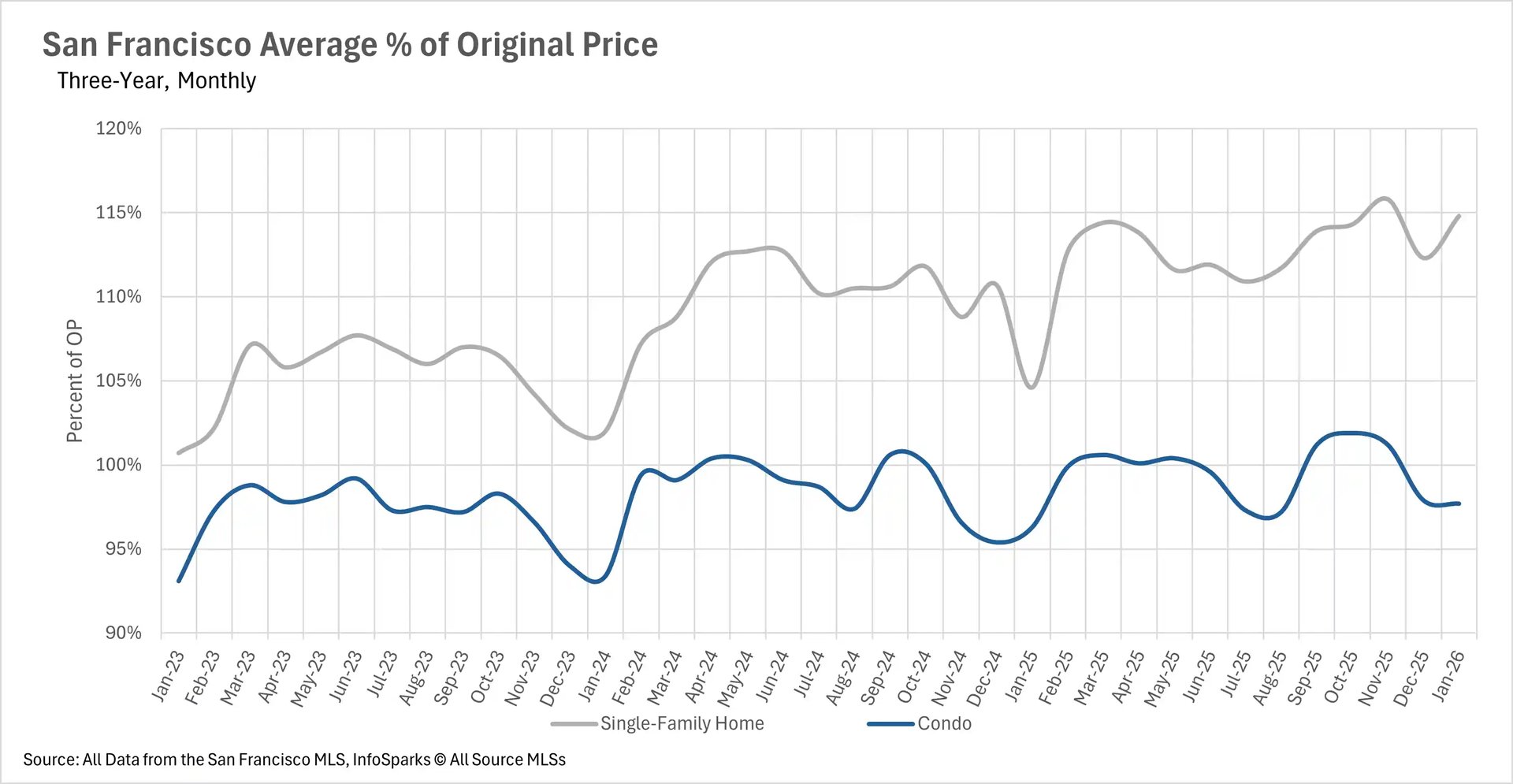
Line chart titled San Francisco Average % of Original Price, Three-Year Monthly showing the average sale price as a percentage of original list price from January 2023 to January 2026 for single-family homes (gray) and condos (blue). Single-family homes consistently sell above list price, rising from about 101% in early 2023 to approximately 115% by January 2026. Condos hover near or just below 100%, ranging between roughly 93% and 102% throughout the period. Source: San Francisco MLS, InfoSparks.

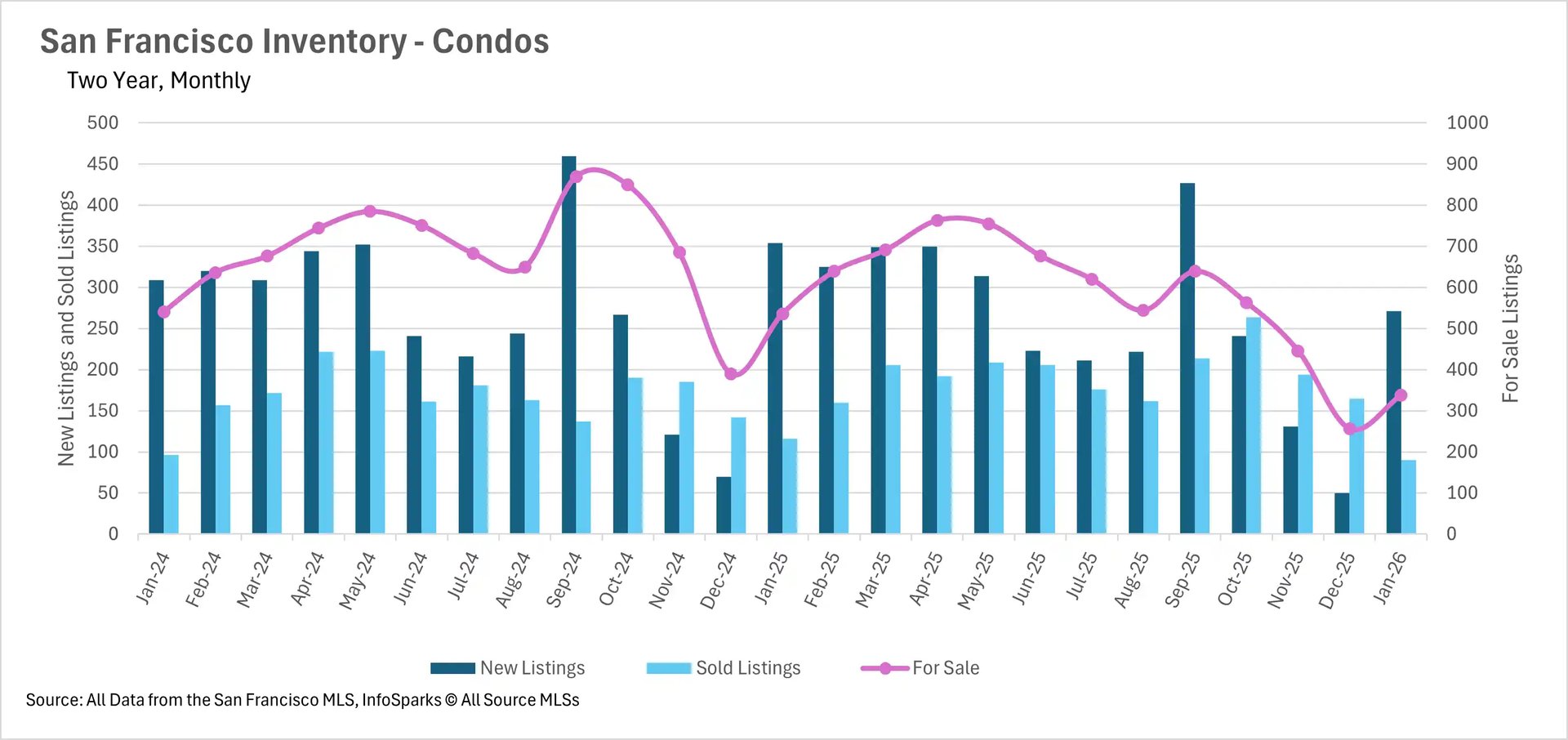
Combined bar and line chart titled San Francisco Inventory Condos, Two Year Monthly covering January 2024 through January 2026. Dark blue bars represent new listings, light blue bars show sold listings, and a pink line tracks total for-sale inventory on the right axis. New listings peak around September 2024 at roughly 455 and again in September 2025 near 425. For-sale inventory peaked around 875 to 900 in September through October 2024 and has since declined to approximately 325 by January 2026. Sold listings remain relatively stable between 90 and 220 per month. Source: San Francisco MLS, InfoSparks.

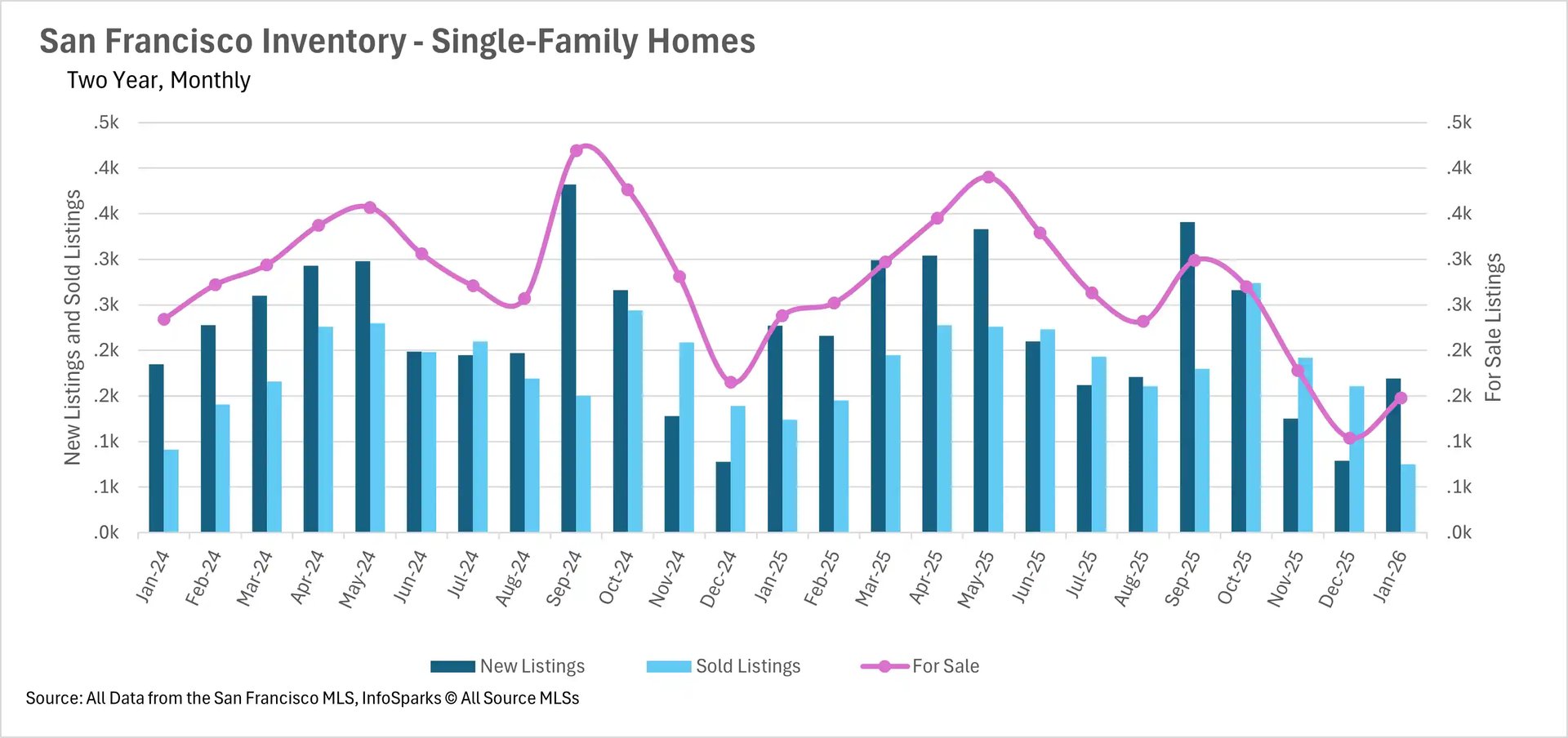
Combined bar and line chart titled San Francisco Inventory Single-Family Homes, Two Year Monthly covering January 2024 through January 2026. Dark blue bars represent new listings, light blue bars show sold listings, and a pink line tracks for-sale inventory on the right axis. New listings peak around September 2024 at approximately 350 and again in May through September 2025. For-sale inventory peaked near 450 in September 2024 and declined sharply to around 200 by January 2026. Sold listings range between roughly 75 and 265 per month. Source: San Francisco MLS, InfoSparks.

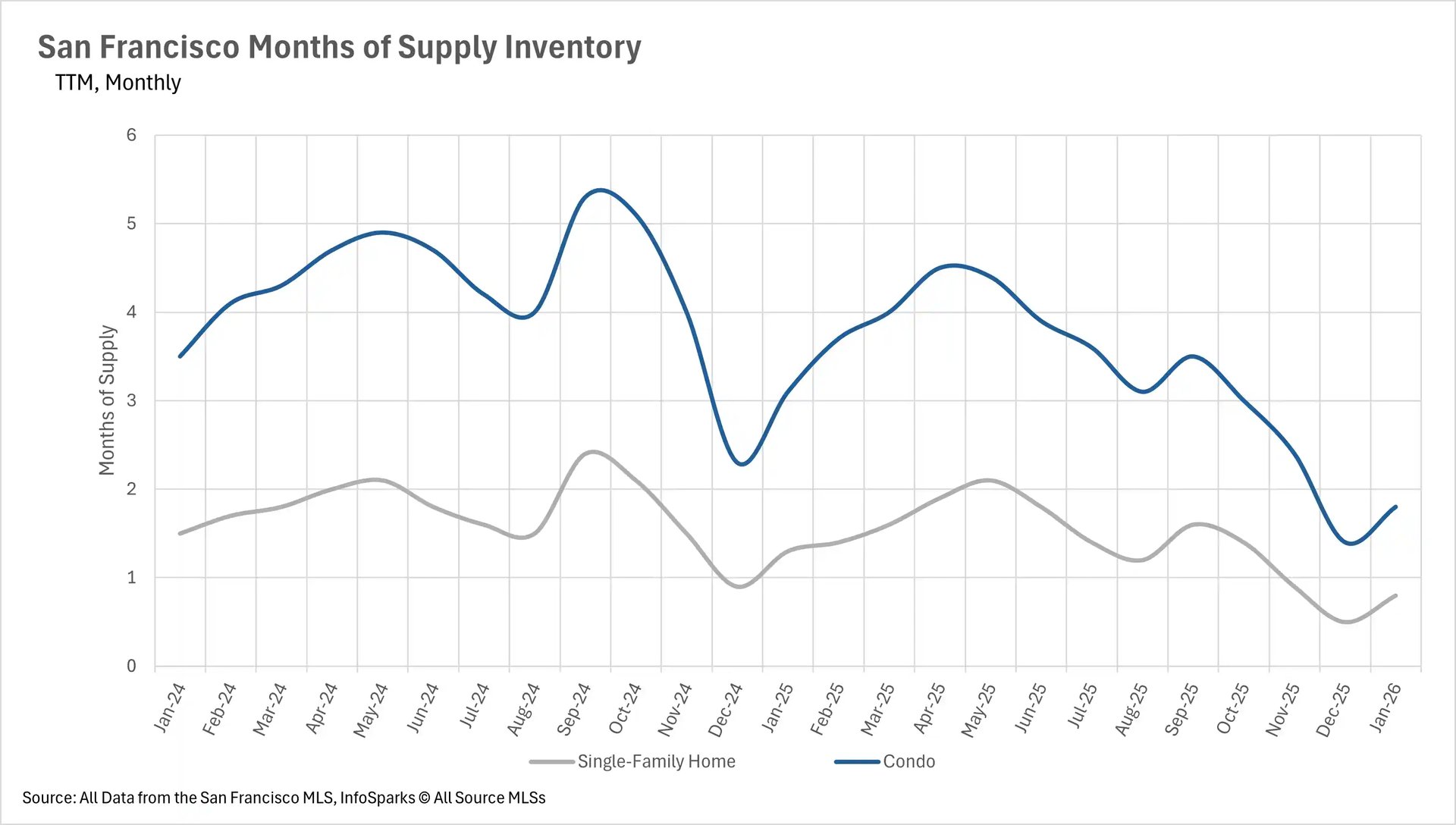
Line chart titled San Francisco Months of Supply Inventory, TTM Monthly from January 2024 to January 2026 for single-family homes (gray) and condos (blue). Condo supply peaked around 5.3 months in September through October 2024, dropped to about 2.3 months in January 2025, rose again to 4.5 months by April through May 2025, and declined sharply to approximately 1.8 months by January 2026. Single-family home supply remained much lower throughout, ranging from about 0.6 to 2.4 months, ending near 0.8 months in January 2026, firmly in seller's market territory. Source: San Francisco MLS, InfoSparks.

Line chart titled San Francisco Days on Market, TTM Monthly from January 2024 to January 2026 for single-family homes (gray) and condos (blue). Condos take significantly longer to sell, starting near 79 days in January 2024, dropping to around 18 days in February 2024, then rising to a peak of approximately 81 days in January 2025 before declining and rising again to roughly 65 days by January 2026. Single-family homes sell much faster, consistently averaging between 12 and 30 days throughout the entire period, ending around 13 days in January 2026. Source: San Francisco MLS, InfoSparks.

Let’s Talk

You’ve got questions and we can’t wait to answer them.

Follow Us on Instagram