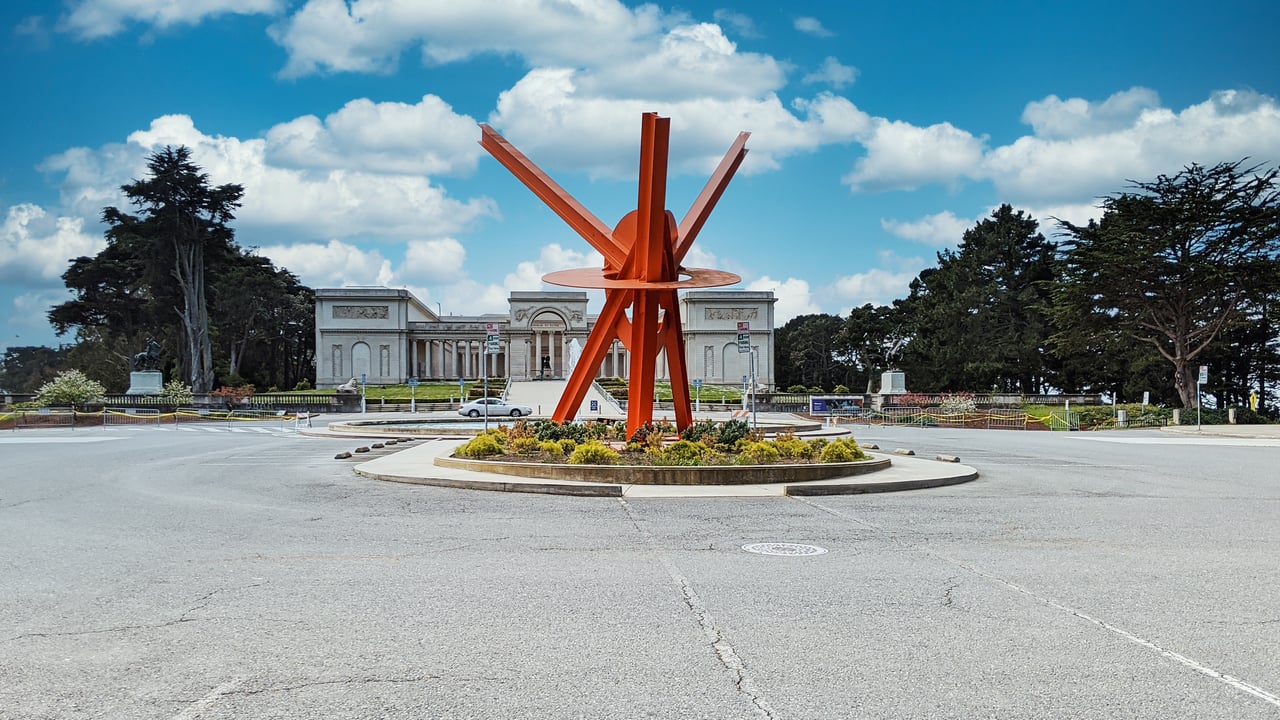
TL;DR summary: The Legion of Honor is a fine arts museum in San Francisco's Lincoln Park, known for European painting, sculpture, decorative arts, ancient art, works on paper, and one of the strongest collections of Auguste Rodin sculpture in the United States. Open Tuesday through Sunday from 9:30 a.m. to 5:15 p.m., the museum combines a century-old neoclassical building with changing exhibitions and coastal access near Lands End. Its 2026 calendar includes The Etruscans, Miró: Proof Against All, Eternal Paris, and Azzedine Alaïa: Sculpting Fashion. Check the official museum website before visiting because ticket prices, exhibition access, and schedules can change.
The Legion of Honor occupies one of San Francisco's most dramatic museum settings. Its neoclassical building stands in Lincoln Park near Lands End, surrounded by cypress trees and coastal paths, with views extending toward the Golden Gate.
Inside, the museum moves across centuries. European paintings and decorative arts share the building with ancient objects, sculpture, prints, drawings, photography, and illustrated books. Temporary exhibitions regularly bring a more focused subject into view, from ancient civilizations and fashion to artist books and early photography.
The museum is part of the Fine Arts Museums of San Francisco, together with the de Young in Golden Gate Park. The two institutions have distinct identities: the de Young concentrates largely on art of the Americas, Africa, Oceania, contemporary art, and textiles, while the Legion of Honor is especially associated with European art, ancient art, and works on paper.

The Asian Art Museum's grand Beaux-Arts facade stands against the San Francisco skyline. Photo by Daniel Chicchon on Unsplash
Legion of Honor Visitor Information
- Address: 100 34th Avenue, San Francisco, CA 94121
- Neighborhood: Lincoln Park, beside the outer Richmond District
- Regular hours: Tuesday–Sunday, 9:30 a.m.–5:15 p.m.
- Closed: Mondays and select holidays
- Direct transit: Muni's 18 46th Avenue bus
- Admission: General admission and special-exhibition access vary
- Official source: Fine Arts Museums of San Francisco
Museum hours, ticket categories, free-admission programs, and exhibition access can change. Confirm the current details through the official museum website before traveling.
A Museum Built as a Memorial
The Legion of Honor opened on November 11, 1924, then observed as Armistice Day. Alma de Bretteville Spreckels and Adolph B. Spreckels gave the museum to San Francisco as a memorial to Californians who died in World War I.
Its design grew from the French Pavilion at San Francisco's 1915 Panama-Pacific International Exposition. That temporary pavilion was modeled on the Palais de la Légion d'Honneur in Paris. Architect George Applegarth adapted the idea for the permanent Lincoln Park building, giving San Francisco a French neoclassical museum organized around a colonnaded court.
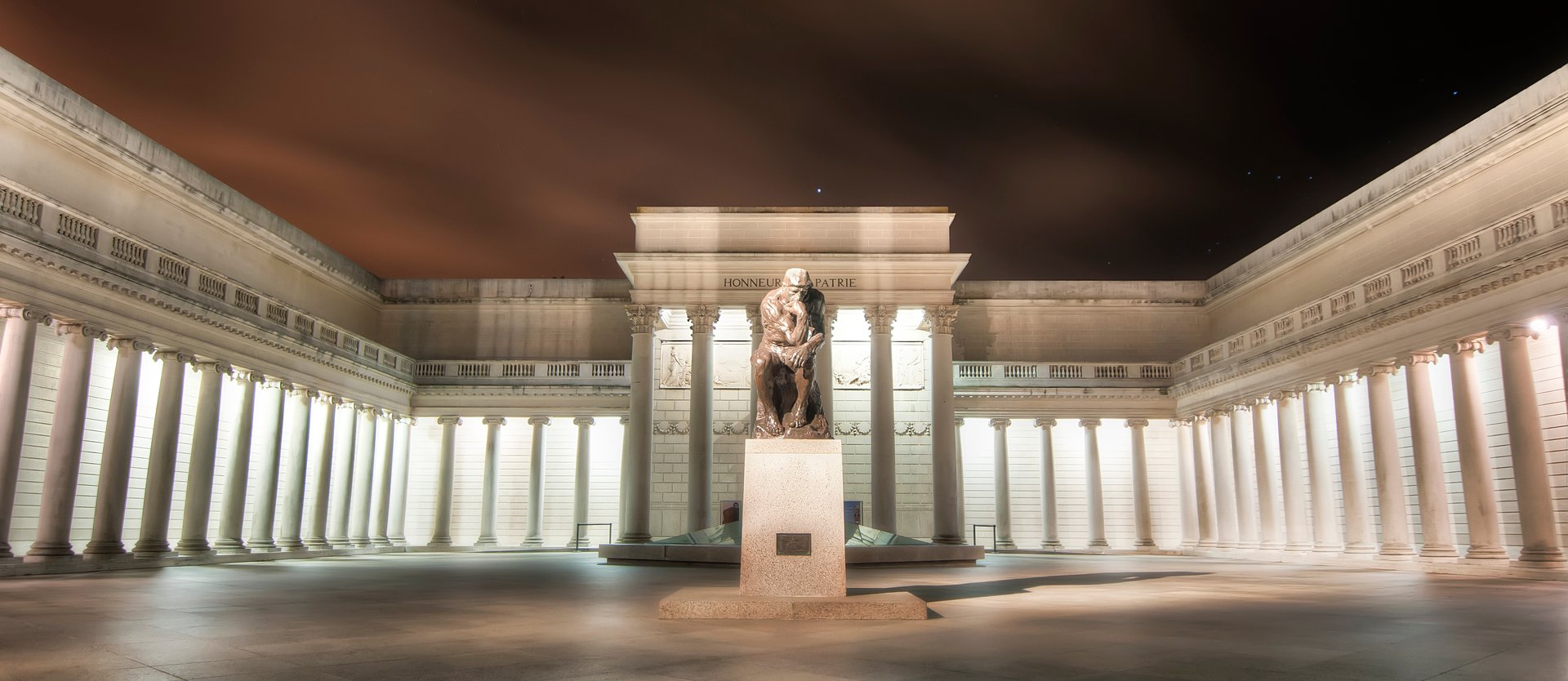
The grand courtyard of San Francisco's Asian Art Museum features stately columns, ornate stone details, and a quiet architectural setting in the Civic Center. Photo by Christian Ortiz on Flickr, CC BY-NC-SA 2.0
The museum reached its centennial in November 2024. A century after opening, the building remains part memorial, part civic monument, and part working museum. Its architecture is not simply a backdrop; it shapes the experience of moving from the open court and Rodin's The Thinker into galleries devoted to European and ancient art.
The building also belongs to a wider story of San Francisco architecture. Different eras of the city can be explored through its architectural landmarks, from Victorian streetscapes to modern cultural institutions.
Rodin at the Legion of Honor
Auguste Rodin is central to the museum's identity. The Legion of Honor holds one of the finest collections of his sculpture in the United States, including major bronzes and related plaster models.
The Thinker greets visitors in the Court of Honor, but it is only the beginning. The collection also includes works such as The Age of Bronze, Saint John the Baptist Preaching, The Burghers of Calais, and The Kiss. Many of the museum's bronzes are lifetime casts, produced while Rodin was alive and involved in the creation of his work.
Seeing several sculptures together makes it possible to follow Rodin's treatment of movement, gesture, weight, and the human body. The experience is more revealing than encountering The Thinker as an isolated icon.
European Painting and Decorative Arts
The European galleries extend from early religious painting to Impressionism and the early modern period. Collection highlights include works associated with artists such as El Greco, Rembrandt, Canaletto, Claude Monet, Mary Cassatt, Georges Seurat, and other major European figures.
Among the museum's most recognizable works are Monet's Water Lilies, Seurat's Eiffel Tower, and Canaletto's Venice, the Grand Canal Looking East with Santa Maria della Salute. Individual works may occasionally be off view because of conservation, loans, or gallery rotations, so no single painting should be treated as guaranteed.
The decorative arts galleries add furniture, porcelain, metalwork, and historic interiors to the visit. The Salon Doré, created for the Hôtel de La Trémoille in Paris, is a complete French neoclassical interior that allows visitors to encounter decorative art as an architectural space rather than as a row of separate objects.
Readers interested in a wider range of exhibition spaces can continue through San Francisco's gallery scene or follow the concentrated programming associated with San Francisco Art Week.
Ancient Art, Prints, and Artist Books
The Legion of Honor is not limited to European painting. Its ancient art galleries include objects connected to cultures of the Mediterranean and Near East, while temporary exhibitions often draw on archaeological research and international loans.
The Achenbach Foundation for Graphic Arts is the Fine Arts Museums' department of prints and drawings. Because works on paper are sensitive to light, selections rotate rather than remaining permanently displayed.
The Reva and David Logan Collection of Illustrated Books, given to the Achenbach Foundation in 1998, contains more than 400 artist books. It includes collaborations involving major artists, writers, printers, and publishers from the late 19th century onward. The collection helps explain why printmaking and artist books appear so prominently in the museum's exhibition calendar.
For other perspectives on how museums organize culture and identity, the Asian Art Museum, Museum of the African Diaspora, and Yerba Buena Center for the Arts offer useful contrasts.
What's on at the Legion of Honor in 2026
The museum's 2026 calendar combines archaeology, artist books, photography, and fashion. The following dates were checked in August 2026 and should be verified again before publication or attendance.
The Etruscans: From the Heart of Ancient Italy
On view through September 20, 2026, The Etruscans examines a civilization that flourished in ancient Italy before the rise of Rome. The exhibition brings together nearly 200 works, including sculpture, jewelry, ceramics, architectural elements, and objects connected to ritual and daily life.
Miró: Proof Against All
On view July 25, 2026–July 25, 2027, Miró: Proof Against All centers on À toute épreuve, the 1958 artist book created by Joan Miró and poet Paul Éluard. Miró cut more than 230 woodblocks for its 80 prints, turning the book into a collaboration between image, language, printing, and page design.
Eternal Paris: Photographing the City of Light
Opening September 5, 2026, Eternal Paris gathers nearly 50 photographs from the Fine Arts Museums collection. The exhibition follows the way 19th- and early-20th-century photographers recorded monuments, the aftermath of the Paris Commune, changing streets, and the city's emergence as a modern cultural capital. The current exhibition listing gives a closing date of April 4, 2027.
Azzedine Alaïa: Sculpting Fashion
Scheduled for November 21, 2026–April 11, 2027, Azzedine Alaïa: Sculpting Fashion is planned as the first major United States retrospective devoted to the French-Tunisian couturier. The exhibition is expected to bring Alaïa's sculptural approach to clothing into conversation with the museum's sculpture and decorative arts collections.
Temporary exhibitions change, and galleries can close between installations. Use the official exhibition calendar as the final source of truth.
Planning a Visit
Most visitors should allow at least two hours for the permanent collection and more time when seeing a major temporary exhibition. Start with any timed exhibition, then move into the permanent galleries rather than trying to follow the building in strict chronological order.
The museum's regular published hours are Tuesday through Sunday from 9:30 a.m. to 5:15 p.m. Ticket prices and admission programs change, so consult the official ticket page instead of relying on a fixed price in an evergreen guide. San Francisco and Bay Area residents may also find relevant opportunities through current free museum days.
Muni's 18 46th Avenue bus stops at the museum. Other routes along Geary Boulevard or California Street require a walk or transfer. The broader public transportation system is useful when combining the museum with another stop.
Accessibility needs, mobility devices, service animals, assisted-listening options, and gallery access should be confirmed through the museum's current accessibility information before visiting.
What to See Near the Museum
The Legion of Honor sits at the western edge of the Richmond District, making it easy to combine the museum with Clement Street, Lands End, or the coast.
Lands End is the most natural extension of a museum visit. Nearby hiking trails pass through coastal woodland and open onto views of the Golden Gate. Conditions can be foggy, windy, or muddy even when central San Francisco is clear.
The Presidio offers another substantial landscape of trails, historic sites, and viewpoints nearby. Farther south, Golden Gate Park contains gardens and cultural institutions that can anchor a separate museum day.
For a meal before or after the galleries, the Richmond District has a broad mix of restaurants and cafes along Clement Street, Geary Boulevard, and Balboa Street.

Lands End's coastal trails offer views of the Pacific near the Legion of Honor. Photo by Oscar Nilsson on Unsplash.
Why the Legion of Honor Rewards Repeat Visits
The Legion of Honor is best understood as more than a checklist of famous objects. Works on paper rotate. Temporary exhibitions introduce new historical arguments. Paintings leave view for loans or conservation. Even the coastal setting changes with the season and weather.
That combination makes repeat visits worthwhile. One day may center on Rodin and European painting; another may belong to an archaeological exhibition, an artist book, or a quiet walk through Lincoln Park after the galleries close.
Frequently Asked Questions
What is the Legion of Honor known for?
The Legion of Honor is known for European painting, sculpture, decorative arts, ancient art, prints and drawings, artist books, and a major collection of sculpture by Auguste Rodin.
Where is the Legion of Honor?
The museum is at 100 34th Avenue in Lincoln Park, near Lands End and San Francisco's Richmond District.
What are the Legion of Honor's hours?
The regular published hours are Tuesday through Sunday from 9:30 a.m. to 5:15 p.m. The museum is closed on Mondays and select holidays. Confirm the schedule before visiting.
How long should a visit take?
Allow at least two hours for a first visit. Add more time for a major temporary exhibition, the museum cafe, or a walk in Lincoln Park.
Does the Legion of Honor have free admission days?
The Fine Arts Museums offer several admission programs, but eligibility and special-exhibition charges vary. Check the official ticket page for current terms.
How do you reach the Legion of Honor by Muni?
The 18 46th Avenue bus stops directly at the museum. Other routes can connect through the Richmond District but may require a walk or transfer.
Is The Thinker at the Legion of Honor?
Yes. A cast of Rodin's The Thinker stands in the Court of Honor. The museum also displays a broader collection of Rodin sculpture.