Martin Luther King Jr. Day stands as the only federal holiday dedicated to a private citizen whose moral philosophy reshaped a nation. Observed on the third Monday of January, it honors a legacy rooted in nonviolence, moral clarity, and democratic accountability.
The day is not merely commemorative; it is aspirational. It invites reflection on unfinished work and unfulfilled promises. In San Francisco, this vision is brought to life through the stewardship of the Norcal MLK Foundation. As the architects of the city’s official observances, they orchestrate a massive convergence of culture and activism—from the Freedom March to the Liberation Film Festival—ensuring the holiday remains a catalyst for community connection rather than just a date on the calendar.
The Significance: Why MLK Day Resonates in San Francisco
In San Francisco, these ideals resonate with particular intensity. The city’s self-conception—progressive, pluralistic, and outspoken—aligns naturally with King’s insistence on justice as a public good. MLK Day here is less a static remembrance and more a civic rehearsal, a moment when values are tested against lived reality.
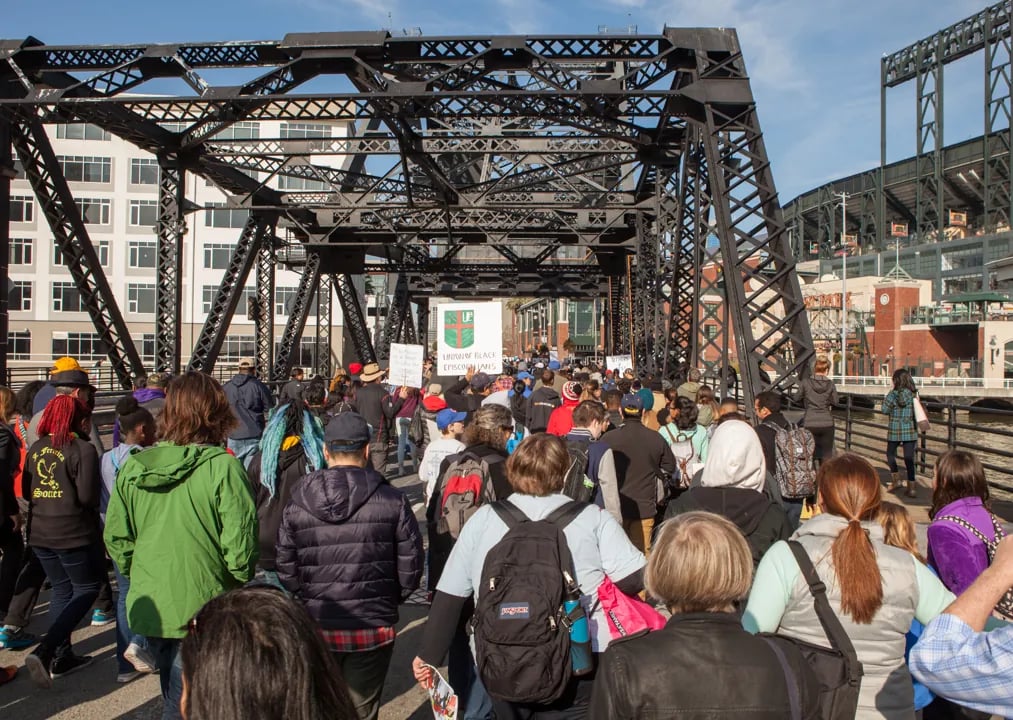
A large crowd crossing the historic Lefty O'Doul Bridge (3rd Street Bridge) near Oracle Park during the Martin Luther King Jr. Day march in San Francisco. Photo by Pax Ahimsa Gethen on flickr, CC BY-NC-SA 2.0
Bay Area Activism and Local Leadership
While often eclipsed by Southern narratives, the Bay Area played a consequential role in the civil rights era. San Francisco and neighboring cities fostered coalitions that addressed:
- Housing Discrimination: Combating redlining and segregation in the Western Addition and Bayview.
- Employment Inequity: Demanding fair hiring practices in the maritime and industrial sectors.
- Police Accountability: Early grassroots movements calling for reform.
Churches, labor unions, and student groups formed an intricate lattice of resistance and reform, echoing King’s call for organized, disciplined action.
Crosscurrents of Race, Labor, and Justice
The city’s civil rights history is inseparable from its labor movements. Dockworkers, domestic workers, and public employees pressed for dignity alongside racial justice advocates. This confluence produced a distinctive activism—pragmatic yet principled—that continues to shape modern MLK Day observances.
The Freedom March and Public Gatherings
Each year, San Francisco hosts marches and rallies, most notably the annual MLK Celebration Freedom March. These events wind through civic spaces, transforming streets into corridors of remembrance.
- The Atmosphere: These gatherings are multigenerational and multilingual. Banners ripple in the coastal air while voices rise—sometimes solemn, sometimes jubilant.
- The Purpose: The emphasis is collective presence, a visible affirmation that justice requires bodies as well as beliefs.
Educational Forums and Cultural Programming
Beyond the streets, universities, community centers, and faith institutions convene panels and lectures. Scholars and activists dissect King’s writings with fresh acuity, situating them within contemporary dilemmas. The tone is rigorous, not reverential; inquiry is encouraged, and complexity is embraced.
A "Day On, Not a Day Off": Service in San Francisco
San Francisco frames MLK Day as a call to service. Volunteerism becomes the lingua franca of commemoration. Residents repair parks, distribute food, mentor students, and assist seniors. These acts, modest in isolation, accrue moral weight through scale and intention.
Community-Based Impact Projects
Neighborhood organizations curate projects attuned to local needs, creating a unifying thread of agency. Common initiatives include:
- Environmental Stewardship: Habitat restoration along the coastline and parks.
- Food Security: Volunteering at food banks to address urban hunger.
- Educational Equity: Mentorship programs and book drives.
Service here is not charity dispensed from above; it is solidarity enacted side by side.
Arts, Culture, and Reflection
Artistic expression occupies a central place in San Francisco’s MLK Day observances. Gospel choirs, spoken-word poets, and contemporary musicians translate King’s ethos into sound and movement.
Museums, Libraries, and Public Memory
Cultural institutions, such as the Museum of the African Diaspora (MoAD) and the San Francisco Public Library, often mount exhibitions that contextualize King within broader struggles for human rights. Archival photographs and oral histories invite prolonged engagement. Memory here is curated but not sanitized—it retains its edges.
Youth, Education, and the Future
Schools across the city integrate MLK Day into curricula that emphasize civic responsibility. Students lead assemblies and facilitate discussions, ensuring the pedagogical aim is empowerment, not indoctrination.
Intergenerational Dialogue: Forums bridge experience and aspiration. Elders recount moments of protest and perseverance, while youth articulate contemporary concerns with candor. This exchange fosters civic literacy, grounding idealism in historical awareness.
Conclusion: The Enduring Pulse of the City
Ultimately, Martin Luther King Jr. Day in San Francisco functions as a moral checkpoint. It asks whether the city’s policies, practices, and priorities align with its professed values.
San Francisco’s celebrations do not obscure persistent inequities; rather, they surface tensions regarding housing and wealth gaps, framing them as calls to action. The legacy endures not in proclamations, but in persistent, principled effort.